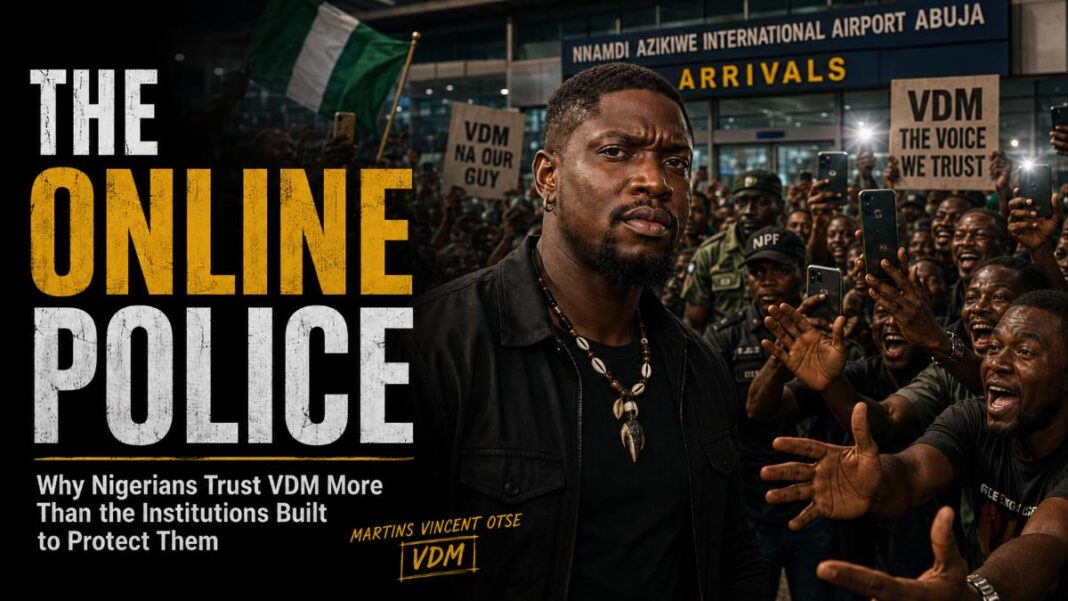

The images moved fast, as images do in Nigeria.
Crowds of young Nigerians, many wearing the colours of the Ratel Movement, surging toward an airport. Phone cameras raised. Voices chanting. A man emerging from the terminal to what can only be described as a civilian welcome ordinarily reserved for heads of state or returning champions.
The man at the centre was not a president. He was not a general. He was not a World Cup hero.
He was Martins Vincent Otse – born in Abuja on 8 April 1994 – known to the 2.7 million people who follow him on Instagram, and the millions more who watch his videos, as VeryDarkMan. Or simply: VDM.
That crowd, documented in social media posts and reels circulating across platforms, was not there by accident. It was there by decision. The decision to show up – physically, publicly, in numbers – and signal something to the Nigerian state: we see you, and we are watching what you do next.
What happened at that airport was not celebrity worship. It was a public referendum on state credibility, conducted not in a polling booth, but at an arrivals gate.
Who Is VeryDarkMan?
There is a version of this story that writes itself in forty words: controversial Nigerian influencer, known for calling out celebrities and fighting corruption online, repeatedly arrested, widely popular with youth.
That version is accurate. It is also completely inadequate.
Martins Vincent Otse is a Nigerian social media commentator and activist whose public identity is built around confrontation, exposure, consumer accountability, and what he calls “online police” work. His own Instagram bio describes him as the “4th arm of the government” and “online police,” a self-designation that is both a provocation and a diagnosis.
He came to prominence around 2022 through a relentless stream of viral videos, targeting celebrities, institutions, banks, pastors, politicians, and public figures. His language is not the language of civil society petitions or editorial board columns. He speaks in the register of the Nigerian street: direct, confrontational, emotionally raw, and frequently impolitic. He does not wait for evidence to be confirmed in court before speaking. He does not moderate his tone for respectability. He names names.
This is either his greatest strength or his most dangerous flaw, depending on who you ask, and in Nigeria, the answer to that question tends to reveal more about the asker than about VDM.
His follower count exceeds 3.1 million on Instagram and 5.2 million on Facebook. The quality of attention his audience pays him, and the speed with which that audience acts, make him significantly important.
The Vacuum He Filled
To understand VeryDarkMan, you must first understand what he replaced.
Nigeria has formal complaint systems. It has the Consumer Protection Council. It has the Central Bank of Nigeria’s consumer protection frameworks. It has the police, the EFCC, the ICPC, the courts, ombudsmen, and regulators. It has investigative journalism, civil society organizations, human rights groups, and NGOs. It has, in short, the full institutional architecture of accountability.
The problem is the collapse of public confidence in those institutions.
When a Nigerian citizen discovers unauthorized deductions from their elderly mother’s bank account, what do they do? They go to the bank. The bank delays. They escalate. Nothing happens. They write a complaint. It is filed away. They call the regulator. They wait. Weeks pass.
Or: they post a video. They tag the bank. They call VDM.
This is not a hypothetical. It is precisely what VDM’s own arrest narrative describes. He did not go to GTBank in Abuja on 2 May 2025 as a provocateur. He went, alongside his mother and a friend, to demand answers about unauthorized deductions from his mother’s account, the kind of visit any citizen has the constitutional right to make to a bank in their country.
What happened next has been documented by multiple Nigerian media outlets: lawyers acting on his behalf reported that VDM was detained by EFCC operatives from the commission’s Special Duty Committee Unit 4 after being apprehended at the GTBank exit door in Garki, Area 3, Abuja.
The EFCC’s official explanation, as reported by Vanguard, was that VDM was picked up “based on several complaints that he used his social media platforms to harass, insult, and intimidate individuals,” actions alleged to contravene the Cybercrimes Act of 2015.
The EFCC declined to identify the complainants.
HURIWA, the Human Rights Writers Association of Nigeria, condemned the arrest, accusing the EFCC of acting as an enforcer for Guaranty Trust Bank rather than a protector of citizens’ rights, and warned that the Cybercrime Act was increasingly being weaponized to silence activists and journalists.
Whether or not that accusation is accurate, it resonated. Because Nigerians have watched this pattern before. The activist who complains too loudly about a powerful institution suddenly finds himself facing legal proceedings. The journalist who asks the wrong questions is served with papers. The ordinary citizen who dares to record a confrontation with police discovers he has become a defendant.
What VDM represents, in the Nigerian public imagination, is the man who kept going anyway.
The Ratel Movement and the Grammar of the Street
His followers call themselves Ratels, named for the honey badger, the relentless scavenger of the African bush, famous for its refusal to back down regardless of the size of the threat.
The name is not accidental. It is a mission statement.
In September 2025, VDM declared that the Ratel Movement would launch a nationwide community service initiative beginning on November 29, 2025, with activities on the last Saturday of each month, a move, in his words, to shift his followers from social media advocacy to physical impact in communities.
He was emphatic that the movement was strictly non-political:
“Political things are not welcomed within our midst. When we are together, we will not welcome any political discussions. Because it is when politics comes that problems begin, followed by tribalism. We are not like that; we are just patriotic Nigerians.”
Martins Otse alias VDM
On November 29, 2025, the pledge was honoured. Across 30 Nigerian states, Ratel volunteers mobilized – clearing gutters, removing refuse, and descending on dumpsites with the kind of civic energy that government environmental agencies had long since given up attempting to generate on their own.
The scale of that mobilization is important. By November 2025, VDM’s social media followers exceeded 7 million, built not through entertainment but through confrontation, accountability campaigns, public call-outs, borehole projects, and school renovations.
“Welcome back the voice for the voiceless,” one commenter wrote after his EFCC release. “Welcome back our president.”
Another: “Our parents’ generation failed us. Don’t let our generation fail and fail the next generation to come.”
The emotional register of those comments is not fan devotion. It is grief. It is the language of people who have watched institution after institution fail them, and have placed what remains of their civic faith in a man who, whatever his flaws, reliably shows up.
The Money Question
In October 2024, VeryDarkMan did something that moved him from online critic to public custodian of real resources.
He launched an NGO.
The Martins Vincent Otse Initiative, launched on October 14, 2024, raised over ₦33 million within 24 hours to address Nigeria’s educational challenges, including outdated teaching methods, inadequate resources, and a lack of motivated educators, especially in rural and underserved areas. Days later, music mogul Don Jazzy contributed ₦100 million, bringing total donations to over ₦200 million.
At the launch, VDM was explicit about his standard for the initiative. He criticized other NGOs for misusing funds and enriching themselves rather than serving the public, and promised full transparency with his initiative.
In late December 2024, VDM posted a video claiming that hackers had breached his NGO’s website and stolen ₦180 million from the official account, leaving only ₦20 million. He described being distressed and said he was working with the police to recover the funds.
The claim convulsed Nigerian social media. Concern poured in. Anger followed.
Then came the reversal.
VDM subsequently admitted the claim was a deliberate prank, a “meticulously planned social experiment,” in his words, designed to expose what he described as the gullibility of social media users.
He later appeared on social media displaying his NGO’s bank statement, showing a balance of ₦240 million.
The backlash was swift and not entirely partisan. Critics who had never liked VDM said it confirmed their suspicions. But supporters who had rallied, worried, and defended him also expressed betrayal. Isaac Fayose publicly stated that one does not prank people with their donated money, and questioned when VDM would begin disbursing NGO funds.
This episode sits at the precise contradiction at the centre of the VDM phenomenon: a man who demands accountability from institutions while using methods that call his own accountability into question. He is simultaneously the inspector and the inspected. The judge and the defendant. The mirror and the mirror’s subject.
That is not hypocrisy, necessarily. It is complexity. But it is a complexity that serious journalism must not flinch from.
The Legal Architecture of Pressure
VDM’s legal and security history is not a peripheral footnote to his story. It is the story.
In May 2024, he was arraigned at the Federal High Court in Abuja on five counts of cyberstalking, charges stemming from alleged online harassment of the Nigeria Police Force and Nollywood actresses Iyabo Ojo and Tonto Dikeh.
In March 2025, a Magistrate’s Court in Wuse Zone 6, Abuja, issued a bench warrant for his arrest on charges of criminal defamation of the gospel singer Mercy Chinwo’s reputation after he failed to appear before the magistrate. Mercy Chinwo also filed a separate lawsuit in the High Court of the FCT seeking ₦1.1 billion in damages.
Then came May 2, 2025, the GTBank incident and the EFCC detention.
VDM was held for five days before release. His attorney, activist-lawyer Deji Adeyanju, noted that the EFCC chairman was cooperative throughout the process, suggesting a resolution had been negotiated.
During the detention, Ratels staged widespread protests, including a large crowd that stormed the GTBank headquarters in Abuja. His lawyer called them “one of the most potent agitators against oppression and tyranny in Nigeria today.”
The Question Nigeria Does Not Want to Answer
Let us ask the question plainly.
What kind of country produces a citizen so distrusted by its institutions, arrested multiple times, bench-warranted, surveilled, alleged to have been ambushed at a bank exit, and yet so trusted by ordinary crowds that supporters gather at airports to protect him from the state?
The answer is not flattering to anyone.
It is a country where the institutions tasked with protecting citizens have so often been turned against citizens that the public has stopped assuming good faith. Where a bank can allegedly deduct money from an elderly woman’s account and face no meaningful regulatory consequence until a son with millions of followers makes noise. Where the EFCC, established to fight financial crime at the elite level, deploys operatives to arrest a man for posting videos, on the same day, he visits a bank with his mother.
VDM is not a saint. He is not a villain. He is what Nigeria produced when it failed its people long enough.
The accountability paradox at the heart of this story is not a contradiction to be resolved. It is a symptom to be read. When a country’s citizens trust an influencer more than their institutions, the problem is not the influencer. The problem is what made his rise not just possible, but necessary.
Nigeria has, in effect, outsourced moral enforcement to social media because its institutional apparatus is procedurally alive but emotionally dead. The EFCC files reports. The courts issue warrants. The police deploy officers. And yet, for millions of ordinary Nigerians, none of these mechanisms feels like they work for them. They feel like they work for whoever has enough money or enough connections to direct them.
VDM offers something different: speed, noise, and the appearance of consequence. It is imperfect. It is sometimes reckless. It bypasses due process. It can harm the innocent. These are real and serious failures.
But they are not why over seven million people watch his videos.
They watch because in a country where official silence is the default response to citizen suffering, VDM is loud.
The Akatarian Lens: What the Diaspora Should Understand
For Nigerians watching from Canada, the United States, the United Kingdom, or elsewhere in the diaspora, the temptation is to view VDM through the comfortable distance of critique. He is messy. He is provocative. He is not the polished civil society leader we might hold up internationally.
But the diaspora’s distance should not become detachment.
The Nigerian state that arrested VDM for visiting a bank with his mother is the same state whose failures drove millions of Nigerians abroad in the first place. The institutional collapse he navigates daily, the distrust, the powerlessness, the sense that rules apply only to those who cannot pay their way out, is not separate from the japa generation’s story. It is the engine of it.
What VDM represents, imperfectly, recklessly, sometimes irresponsibly, is a generation of young Nigerians who have decided not to leave for the airport and not return. Those who have decided to stay and be loud. Who are naming names, demanding receipts, building boreholes, renovating schools, and cleaning gutters when the government will not?
The diaspora that left to build better lives elsewhere has a responsibility not to romanticize that decision by falling silent about those who stayed.
VDM is not the answer to Nigeria’s institutional crisis. But he is the most visible evidence that the crisis exists.
The Closing Question
Even if VeryDarkMan is silenced tomorrow – arrested, charged, convicted, or simply exhausted – the phenomenon that produced him will not disappear.
There are hundreds of thousands of young Nigerians who watched what happened at GTBank in May 2025 and drew a conclusion. Not about VDM specifically. About the system. About what the system does to those who challenge it. About what the system protects and what it leaves exposed.
“Our parents’ generation failed us,” one Ratel wrote. “Don’t let our generation fail and fail the next generation to come.”
That is not a statement about VeryDarkMan. That is a statement about Nigeria. About the accumulated weight of institutional betrayal. About a generation that has inherited a country whose formal mechanisms promised protection and delivered predation.
The real question is not whether VDM is right or wrong, trustworthy or reckless, hero or fraud.
The real question is this: When the next VDM arrives, and someone always does when institutions fail, will the Nigerian state have rebuilt enough trust to make the crowd unnecessary?
As things stand, the answer is no.
And that is the underbelly of this story. Not the man at the arrivals gate. Not the crowd raising phones to film him. Not even the government that sent operatives to a bank exit to detain a man who was filing a consumer complaint on behalf of his mother.
The underbelly is the country that made it all normal.
This investigation was produced by Akatarian Media for Akatarian.com – a diaspora-focused media platform committed to accountability journalism on African governance, faith, and civic life. Factual claims in this piece are drawn from reporting by Premium Times, Vanguard, Daily Post, The Whistler, Sahara Reporters, and verified social media documentation. Allegations are identified as such. Readers are encouraged to consult primary sources.