
Nigeria keeps asking its killers to surrender. The killers keep saying no.
On the morning of June 12, 2026, two Nigerias woke up.
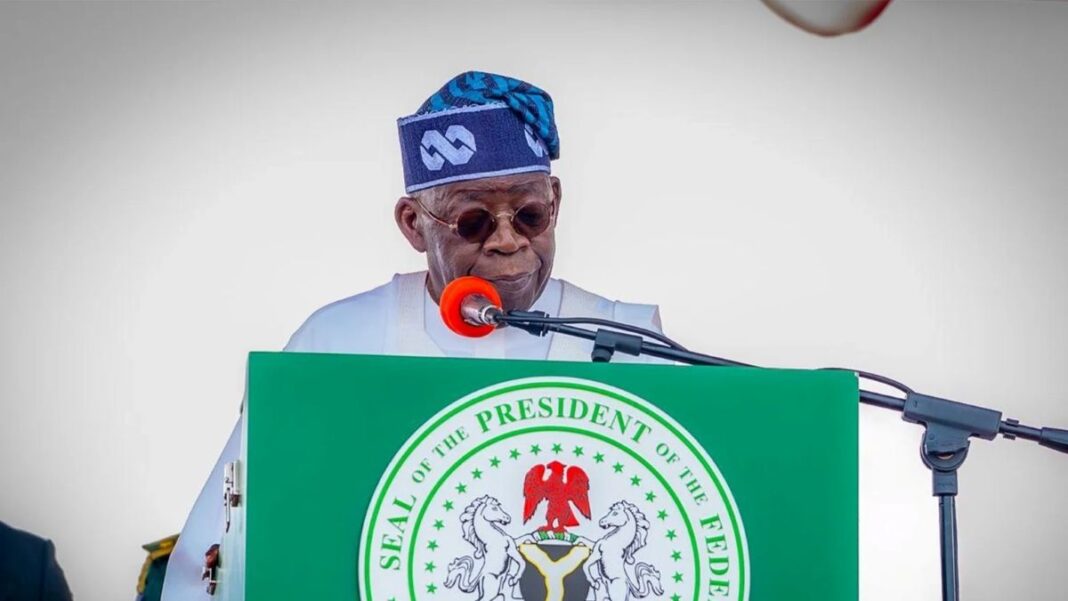
In the first Nigeria, the cameras were ready. It was Democracy Day, the 27th unbroken year of civilian rule, and President Bola Ahmed Tinubu sat before the nation to deliver his fourth address since taking office. His message, his speechwriters surely believed, was firm.
In the second Nigeria, a mother in Oriire, Oyo State, marked another morning without her child. It had been roughly a month since gunmen stormed the Esiele and Yawota communities and marched schoolchildren into the forest. In Mussa, a town in Borno State’s Askira-Uba area, families of 42 abducted pupils, some as young as two years old, were still waiting. A vice-principal taken in the Oyo raid had appeared in a hostage video days earlier, pleading with the government to consider his captors’ demands.
It was to both Nigerias that the President spoke the line that would define the day:
“To bandits, kidnappers, and sponsors of terror: Surrender or face the full force of the Nigerian State. These windows of surrender will not remain open forever. No mercy will be shown to those who trade in the blood of Nigerians.”
In the first Nigeria, it sounded like resolve.
In the second Nigeria, it sounded like a question: Why is there a window at all?
The Children They Could Not Protect
To understand why a single sentence can wound a nation, you have to understand what that nation has already buried.
The arithmetic of Nigeria’s school abductions has become a grim national curriculum. Chibok, 2014: 276 girls taken from their dormitories in Borno, a wound that gave the world the hashtag #BringBackOurGirls and never fully healed – dozens of those girls have never come home. Kuriga, Kaduna State, March 2024: more than 280 pupils and staff seized in a single raid.
Then came November 2025, a month that broke something in the national spirit. In one single week, armed men kidnapped 25 schoolgirls from a school in Kebbi State, 38 worshippers from a church, more than 300 children and teachers from St. Mary’s Catholic School in Papiri, Niger State, and dozens more across the country. A photograph from Papiri travelled around the world: a single pair of children’s shoes, abandoned on a dormitory floor.
And now, in the weeks before this year’s Democracy Day, the cycle has turned again. Children and teachers taken in Oyo and Borno remain in captivity as this report is published. The abduction in Oyo carried a horror that even hardened Nigerians struggled to speak of: reports that one of the abductees and a teacher were beheaded. The Nigeria Union of Teachers declared an indefinite strike on June 1, demanding their rescue. The United Nations’ top humanitarian official in Nigeria called for their immediate release. Security sources told The PUNCH that the abductors are demanding the release of detained terrorist commanders, meaning the kidnappers of children are now negotiating as equals with the Nigerian state.
The President himself acknowledged it. “Though this year’s mood is dampened by the abduction of our children in Oyo and Borno,” he said, “we remain hopeful for their safe return.”
Hopeful. For the second Nigeria, hope is not a security strategy. It is what you are left with when the state has nothing else to offer.
No One Is Untouchable
The case against the rhetoric of “surrender” is not abstract. It has names.
Alhaji Isa Muhammad Bawa was 73 years old, the Emir of Gobir in Sokoto State, a royal father, a custodian of centuries of tradition. In July 2024, bandits took him and his son off the Sokoto–Sabon Birni road. They tied his hands and feet and made him beg on camera. “I am pleading with you all to help me,” the old man said into the lens, telling his people the bandits had set a deadline. The deadline passed. They shot him after the afternoon prayer and buried him themselves. His son was freed only after the family paid ₦60 million and handed over five motorcycles. Days after the Emir’s killing, the same bandits returned to his emirate and abducted more than 150 people.
Brigadier-General Maharazu Tsiga (rtd.) once ran the National Youth Service Corps, the institution that sends Nigeria’s graduates to serve their country. In February 2025, more than 100 armed men surrounded his home in Katsina State and took him. His captors demanded ₦250 million. He spent 56 days in a forest camp before his release.
Major Joe Ajayi (rtd.), 76, was taken from his home in Kogi State in May 2025. His family paid ₦10 million. The kidnappers killed him anyway. His body was recovered and deposited at a hospital mortuary.
Read those three stories again. A king. A general. A veteran. If the men who once embodied the Nigerian state cannot be protected by it, and cannot even buy their own lives back from its enemies, what exactly is the “full force” being held in reserve, and for whom?
The Ledger: Kidnapping as an Industry
The numbers confirm what the stories suggest: this is no longer crime. It is an economy.
According to Locust Business, the 2025 report by Lagos-based risk consultancy SBM Intelligence, between July 2024 and June 2025:
| The Measure | The Figure |
|---|---|
| People kidnapped | 4,722 |
| Recorded incidents | 997 |
| People killed in those incidents | 762 (including 563 civilians) |
| Total ransom demanded | ₦48 billion |
| Ransom actually paid | ₦2.57 billion (about $1.66 million) |
| Victims killed after ransom was paid | At least 32 |
| Mass abductions (5+ victims per incident) | 231 incidents — 23% of all cases |
The Northwest remains the epicentre, accounting for more than 42 percent of incidents and over 62 percent of all victims. Zamfara State alone recorded more than 1,200 abductions.
Behind each line of that table is a family doing terrible math. Paying ransom has been a crime in Nigeria since 2022, punishable by a minimum of 15 years in prison, yet families liquidate savings, sell farmland, and openly crowdfund ransoms on social media, because the alternative is a phone call no parent survives. SBM’s analysts note that ransom bearers themselves have been abducted or killed while delivering the money. And researchers estimate that a significant share of ransom proceeds now flows directly to jihadist groups, meaning every payment that frees one child helps finance the raid that takes the next ten.
This is what the bandits hear when a president offers them a “window of surrender”: the business is still profitable, and the state is still asking.
Anatomy of a Failing Sentence
To be fair to the President, and fairness is owed, his speech was not empty of substance. He told the nation that terror-related deaths have fallen 81 percent since 2015. That security forces neutralized more than 13,000 terrorists in the past year. That over 124,000 fighters and their dependants have laid down arms since 2023 through Operation Safe Corridor. That his government has declared a security emergency, approved the recruitment of more than 50,000 police officers, deployed 1,000 forest guards toward the Oyo rescue effort, and allocated ₦5.41 trillion to defence and security in the 2026 budget, the largest in the nation’s history. He spoke of precision strikes that degraded an ISWAP command centre in Arege, Borno.
These are not nothing. If accurate, they are the makings of a real argument.
But the President did not lead with the argument. He led with the invitation. And that choice exposes three fractures in the language of Nigerian power:
1. The future-tense fallacy. “Surrender or face the full force of the Nigerian State” places the state’s full force in the future, conditional, pending, withheld. After Chibok, after Kuriga, after Papiri, after the Emir of Gobir died tied up on camera, the citizens’ question is immediate and devastating: if the full force exists, why has it been waiting? A threat phrased in the future tense is, to the grieving, a confession about the past.
2. The initiative belongs to the criminal. “These windows of surrender will not remain open forever,” hands the calendar to the enemy. It tells armed syndicates that the timeline is theirs: regroup now, re-arm now, strike at the hour of your choosing, the window will still be open. Twenty-seven years of democracy have taught Nigeria’s warlords to read presidential speeches the way traders read markets. An open window is a holding pattern. A holding pattern is permission.
3. The currency of words is spent. Every Nigerian president since 1999 has warned terrorists. The warnings have outlived the warned-against’s victims. Even on the day of this speech, the debate it ignited told the story: callers flooded radio programmes asking why men who have killed for years are still being offered rehabilitation pathways instead of consequences. When words are issued without visible, overwhelming results, two things depreciate at once: the citizens’ faith in the state’s capability, and the criminals’ fear of the state’s power. The first is hard to rebuild. The second, once gone, is paid for in blood.
What Strength Would Actually Sound Like
Nigeria cannot psychoanalyze its way out of terrorism, and it cannot politely request that mass murderers discover a conscience.
Because here is the truth the second Nigeria already knows: deterrence is not declared. It is demonstrated. A state earns the right to say “no mercy” only after its enemies have learned to expect none.