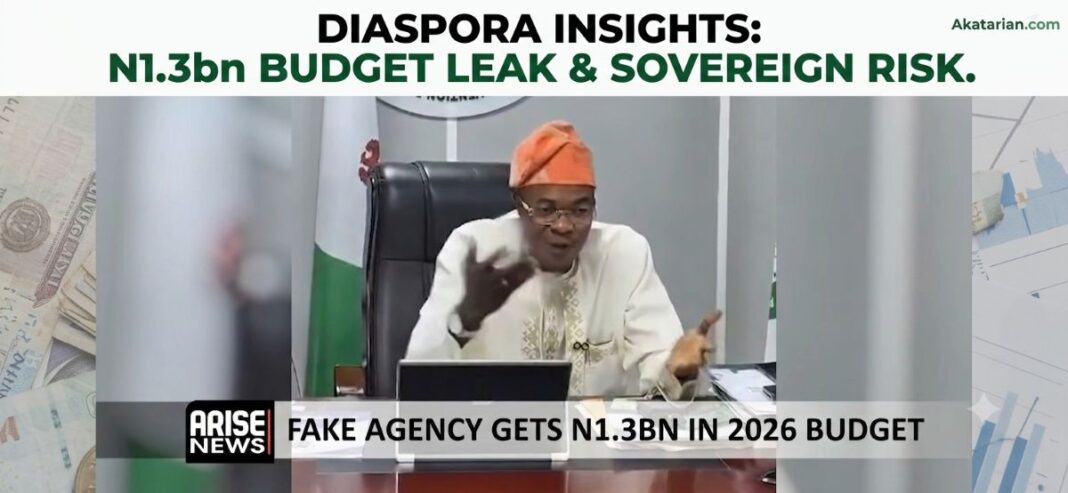

Before anyone stood trial, a woman died.
On October 22, 2025, Dolapo Babatunde Tanimola, the woman Prince Adeniyi Adeyemi Matthew claims connected him to the highest office in Nigeria, died in a hotel fire in Utako, Abuja. Five days later, police officers walked into an office inside the Federal Secretariat, the administrative heart of the Nigerian state, and arrested the man who had been running a “presidential council” out of it for over a year.
The Presidency says that the council, the Presidential Foreign Intervention Promotion Council (PFIPC), never existed.
The 2026 Appropriation Act, signed by President Bola Tinubu, says otherwise. There it sits, on pages 50 and 51 of the nation’s most sacred fiscal document, listed alongside a “Presidential Economic Advisory Council” and allocated ₦1.302 billion. The National Assembly committee conducts oversight and budget defence before any appropriation is passed for Presidential assent.
A budget that funds an agency the government swears is fictional. A CBN account opened in its name. Thirty-four bank accounts traced to one man, nine of them registered to phantom government bodies. A dead intermediary. A manhunt. And now, an eight-count indictment- Charge No. FHC/ABJ/CR/652/2026, FRN v. Prince Adeniyi Adeyemi Matthew & Ors – for forgery, impersonation, and criminal conspiracy, with the President’s own Chief of Staff, Femi Gbajabiamila, listed as a prosecution witness.
To the Nigerian press, this is a political thriller. To the trading floors of London and New York, it is something colder: a data point on institutional integrity. And in sovereign finance, institutional integrity is not a moral category. It is a price.
We call that price the Sovereign Risk Premium. Nigeria has been paying it for years. The Ghost Council explains why it refuses to disappear.
A Scandal That Keeps Metastasizing
The story has moved fast since the charges were filed in November 2025, and every development has made the institutional picture worse, not better.
The trial. Adeyemi was arrested on October 27, 2025, by the IGP Monitoring Unit and held for 23 days before administrative bail on health grounds. His arraignment has been repeatedly stalled: court scheduling, defence adjournments, claims of illness, with court records showing the matter adjourned to July 14, and the Presidency’s own statement placing his next appearance on July 27. A trial that cannot even begin its arraignment eight months after charges were filed is itself a governance signal, and Premium Times’ review of the police case diary documents each delay.
The counter-accusations. In a June 25 press conference, Adeyemi did not merely proclaim innocence. He accused Gbajabiamila of demanding 48 percent of the council’s alleged ₦27.4 billion take-off grant, roughly ₦12.5 billion, and of receiving ₦400 million through intermediaries in connection with appointments. Gbajabiamila, through Senior Advocate Kemi Pinheiro, has denied ever communicating with Adeyemi directly or indirectly, and in a letter dated July 6, threatened criminal defamation proceedings and a ₦10 billion civil suit. Notably, in a subsequent conversation with activist VeryDarkMan, Adeyemi conceded he never met Gbajabiamila in person and could not say with certainty whether the Chief of Staff was involved at all, a walk-back that weakens his bribery narrative even as it deepens the mystery of who, exactly, enabled him.
The presidential response. President Tinubu has now directed the ICPC to conduct a full investigation into the forged appointment letters, the bank accounts, the diplomatic overtures, and, crucially, “the role of any public officer, private individual, financial institution or intermediary” that may have facilitated the scheme, with a report due within 30 days. The President has, in effect, asked his own government the question this column has been asking: how did the gates open?
The collateral damage. Police reportedly detained Adeyemi’s elderly father, officers allegedly cutting through fence wire to enter his Suleja compound, prompting the Human Rights Writers Association of Nigeria to condemn what it called an unconstitutional “substitute arrest,” and drawing criticism from Femi Falana, SAN, who now represents Adeyemi. A forgery case has begun generating its own due-process crisis.
Every claim above sits inside a live judicial process. Adeyemi is presumed innocent. Gbajabiamila has denied every allegation. The Presidency insists no public funds ever entered the disputed CBN account. All of that matters, and none of it resolves the structural question.
The Compliance Autopsy
Strip away the personalities, and the forensic reality remains, because it is drawn from the government’s own investigative disclosures.
According to the Presidency’s account, Adeyemi used forged presidential documents to mislead the Office of the Accountant-General of the Federation into facilitating an official institutional account at the Central Bank of Nigeria. He operated 34 bank accounts, nine in the names of invented government agencies. He secured office space inside the Federal Secretariat. He corresponded with ministries, departments, and agencies on official-looking letterhead. He met with ambassadors, engaged the Speaker’s office, and sought a note verbale from the Ministry of Foreign Affairs to facilitate visas.
For a global rating analyst, the individual counts of the indictment are almost beside the point. In macroeconomic governance, a nation’s central bank and its national budget are supposed to be the single source of absolute truth. The entire architecture of international lending rests on one premise: sovereign systems cannot be casually tricked.
If a fictitious entity can clear the compliance perimeter of a central bank; if it can be transcribed into the Appropriation Act itself; if it can operate for over a year inside the physical seat of government while the agency legally mandated to promote investment, the NIPC, is reduced to raising alarms that a parallel body is working at cross-purposes with it, then the gatekeepers are no longer watching the gates.
They have become the gate.
And here is the question the ICPC’s 30-day report must answer, because Nigeria’s creditors will be reading it: was Adeyemi a con man of singular genius, or was he a stress test that an entire institutional system failed? The first is a crime story. The second is a credit story.
The Eurobond Transmission Mechanism and the Inconvenient Counter-Evidence
Nigeria’s Eurobonds have not sold off on this scandal. Average benchmark yields fell to roughly 6.78 percent in early June, the lowest level of 2026 on the back of firm oil prices, improving FX transparency, and a global risk-on mood. Debt Management Office data show yields ranging from about 5.7 percent on the shortest paper to just over 8 percent at the long end. Foreign investors have been buying, not fleeing.
So has the Ghost Council been costless? No.
First, the premium is structural, not episodic. Even in a rally, Nigeria trades at a persistent yield premium over similarly rated emerging-market sovereigns in Latin America and Asia. Analysts attribute the gap to exactly three things: inflation instability, FX credibility, and institutional risk perception. Oil prices and ceasefire headlines move the cycle. Institutional integrity moves the baseline. The PFIPC affair is a baseline event.
Second, rating methodology is unforgiving on precisely this point. When Moody’s, S&P, and Fitch score sovereign creditworthiness, “institutional strength” and “governance effectiveness” are heavily weighted pillars, and they are assessed on evidence of whether state systems function as designed. A budget porous enough to fund a parallel bureaucracy, and a central bank compliance perimeter breached by forged paper, are the kinds of findings that cap how far an upgrade cycle can run, no matter how good the oil revenue looks this quarter.
Third, the long end of the curve is already telling the truth. Nigeria’s longer-dated bonds have shown bear-steepening episodes through 2026, long-term yields rising faster than short-term ones. This is a classic signature of investors who are comfortable with next year’s cash flows but skeptical of the decade’s institutions.
The cost, then, is not a dramatic spike on a Bloomberg screen the morning after a scandal. It is the compounding difference between what Nigeria pays to borrow and what it would pay if its budget and central bank were treated as unimpeachable documents. On billions of dollars of external debt, in a fiscal environment where debt servicing already consumes an alarming share of real revenue, tens of basis points of “governance premium” are not an abstraction. They are hospitals, classrooms, and roads that were financed at the wrong price, or not at all.
We are, in effect, borrowing expensive international capital to subsidize the leaky, unmonitored plumbing of a phantom economy.
The Diaspora Dilemma
This structural squeeze lands on Akatarian’s core constituency, the African diaspora, with particular severity.
Year after year, the diaspora is asked to be the homeland’s financial backbone, sending home more than $20 billion annually in remittances, a flow that rivals oil as a source of foreign exchange. And year after year, the diaspora is urged to graduate from sentimental transfers to structured commitments: diaspora bonds, infrastructure funds, real estate, portfolio investment.
But every structural governance failure quietly re-prices that ask. When the sovereign risk premium stays elevated, it feeds through to domestic borrowing costs, inflation persistence, and currency volatility. The hard currency sent home by doctors in Ottawa, engineers in Houston, and nurses in London stops functioning as growth capital and starts functioning as a macroeconomic shock absorber, plugging holes the state’s own architecture keeps opening.
And consider what the PFIPC saga says to the very investors Nigeria is courting. The Nigerian Investment Promotion Commission, the lawful front door for foreign capital, sounded the alarm in late 2025 that a counterfeit investment council was operating out of the Federal Secretariat, hosting diplomats and issuing official-looking correspondence. A diaspora professional weighing a diaspora bond against a Toronto index fund now has to ask a question no marketing roadshow can answer: if the state could not verify its own investment council, how will it verify my investment?
Capital does not go where it is courted. It goes where it is protected by predictable, transparent rules.
Treating the Budget as a National Security Document
The Presidency deserves credit for two things: filing charges quickly and ordering the ICPC to examine not just the man but the weaknesses in government procedure that gave a fictitious body the appearance of legitimacy.
But it also concedes the core problem. If the PFIPC is fictitious, the state must still explain to its creditors and its citizens how a private individual allegedly wrote his own script into the appropriation process, cleared the Accountant-General’s office, and touched the Central Bank. An administrative disclaimer cannot fix what a forensic audit has exposed. And if the courtroom on July 27 becomes a stage for duelling defamation suits rather than institutional answers, the markets will draw their own conclusion: that Nigeria investigates personalities, not systems.
The trial should not be celebrated as a victory for state vigilance. Vigilance would have been catching this before it entered the budget. The trial is a flashing red warning light, and the ICPC’s 30-day report is the real test.
Three commitments would tell lenders, rating agencies, and the diaspora that the lesson has been learned:
Publish the ICPC findings in full, including every officer, institution, and intermediary that facilitated the scheme, not a summary. The report.
Subject the Appropriation Act to line-item institutional verification, so that no entity enters the budget without a statutory instrument establishing it. A budget code should be as hard to forge as a banknote.
Audit the CBN and Accountant-General account-opening perimeter against the same AML/KYC standards Nigeria demands of its commercial banks, and disclose the remediation.
Nigeria cannot borrow its way out of an economic crisis if the buckets carrying that capital are riddled with structural holes. Until the phantom bureaucracy is fully excised from the official books, and the process that admitted it is repaired in public view, international lenders will keep charging Nigeria a premium for its uncertainty.
And everyday citizens, alongside the diaspora holding the financial line, will keep paying the bill.