

The recent assertion by Nigeria’s Minister of Education, Dr. Tunji Alausa, that the sharp decline in outbound student mobility is a “reversed trend” driven by renewed confidence, academic stability, and the superior quality of domestic programs like JUPEB, represents a classic case of governance gaslighting. Joint Universities Preliminary Examinations Board, known as JUPEB is Nigeria’s equivalent of the British A-levels
As a governance and policy analyst, analyzing the data reveals that the drop in the Japa phenomenon is not a victory for local educational reforms. Instead, it is the predictable, constrained outcome of restrictive foreign immigration shifts combined with a domestic economic meltdown that has priced the middle class out of international travel.
1. The Policy Shift: Closing Doors in Destination Nations
The Minister’s narrative deliberately ignores structural shifts in global immigration policies that specifically target international students and their families. The massive surge in outbound Nigerian migration peaked up to 2023, forcing major host countries to aggressively alter their visa frameworks. Japa is a Nigerian slang meaning to flee or escape, often for a better life abroad
The United Kingdom (The Primary Target)
- The Dependants Ban (January 2024): The UK Home Office instituted a strict ban preventing international students on taught postgraduate courses from bringing family members (dependants).
- The Impact: Data from the Higher Education Policy Institute (HEPI) shows that Nigeria had the highest dependant-to-main-applicant ratio globally, sitting at 1.24 in 2023. When the policy took effect, Nigerian main applicants to the UK plummeted by 50% in a single year. The drop was driven by policy exclusion, not domestic satisfaction.
Canada and Australia
- Caps and Financial Requirements: Both nations introduced strict caps on international study permits and drastically doubled the “Proof of Funds” (cost of living) requirements. Canada increased its single-applicant financial threshold from $10,000 to over $20,635, effectively shutting the door on mid-tier African applicants.
2. The Economic Realities: The “Naira Power” Collapse
To understand why fewer Nigerians are traveling, one must analyze the brutal macroeconomic indicators since the administration took power in mid-2023. The compounding effects of the floating of the Naira and the removal of the fuel subsidy have crushed the purchasing power required to fund foreign education.
The Exchange Rate Apocalypse
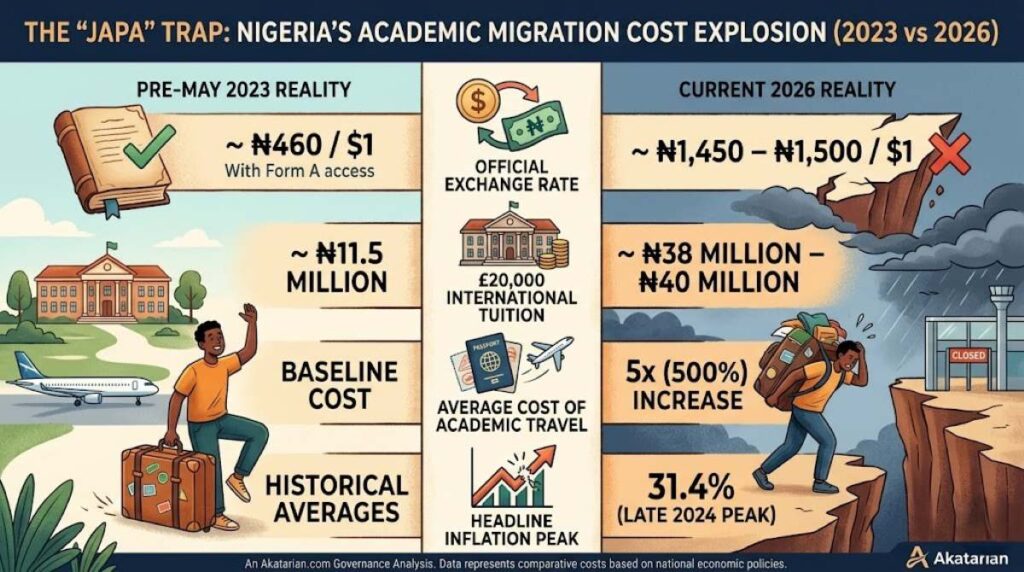
- Pre-May 2023: The official exchange rate hovered around ₦460 / $1, with the central bank providing subsidized “Form A” allocations for student school fees.
- By 2026: The Naira has suffered a catastrophic devaluation, stabilizing around ₦1,450 to ₦1,500 / $1.
- The Math: A modest £20,000 international tuition fee cost approximately ₦11.5 million at the parallel/Form A rates in early 2023. Today, that exact same tuition requires an astronomical ₦38 million to ₦40 million.
Biting Domestic Inflation
- Driven by a major fuel price shock, headline inflation aggressively climbed after 2023, hitting a historic peak of 31.4% in late 2024.
- While inflation has decelerated into the 15.1% – 15.6% range in 2026, the cumulative increase in the cost of basic goods and services means household disposable income has been entirely wiped out.
Analyst Note:
The cost of traveling for academic purposes has escalated 500% (5x) compared to three years ago. The middle class is not staying back because local universities became world-class overnight; they are staying back because they are financially stranded.
3. Where the Minister is Economical with the Truth
Dr. Alausa’s claim that domestic tertiary institutions are thriving under oversubscribed demand (e.g., JUPEB and local law programs) confuses capacity constraints with systemic quality.
- The Fallacy of Excess Demand: Top Nigerian universities turning away applicants due to excess demand is a structural issue that has existed for decades, not a new sign of institutional health. The institutional capacity of Nigerian universities has never matched the youth population boom.
- The R&D and Infrastructure Deficit: Academics and researchers continue to sound the alarm on the total decay of local infrastructure. A vast majority of federal and state universities lack functional, modern research equipment like LC-MS (Liquid Chromatography-Mass Spectrometry), NMR (Nuclear Magnetic Resonance), or proper biomaterial storage systems to support quality research and development.
The Analytical Verdict
When a government claiming victory points to a reduction in citizens leaving the country, it must prove that the reduction is due to attraction at home rather than prohibition abroad and poverty at home.
The “precipitous drop” tracked by the Ministry of Education is an artificial equilibrium. The desire to Japa remains incredibly high, but the financial pathways have been severed by domestic currency failure, and the legal pathways have been narrowed by foreign policy shifts. Framing a structural trapping of citizens as an educational milestone is an indictment of the analytical integrity of our current governance metrics.