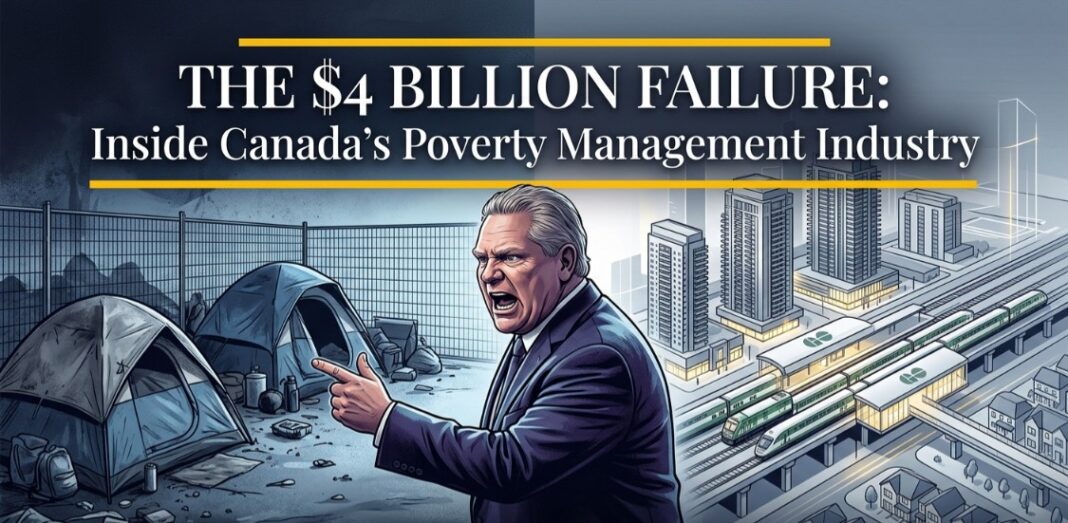

When Ontario Premier Doug Ford frames the Waterloo Region encampment dispute as “30 people trumping millions” of transit riders, he isn’t just using standard political hyperbole, he is running a deliberate distraction. The real crisis in Kitchener is not that 30 unhoused residents are delaying a multi-million-dollar GO Transit expansion. The real crisis is that Canadian governments are spending record amounts of public money to manage the appearance of homelessness while systematically failing to build actual housing.
We are witnessing the institutional entrenchment of a Poverty Management Industrial Complex: a self-perpetuating loop where emergency response budgets soar, private security firms clear tents, municipal bylaws end up in court, and the actual human suffering on the ground only intensifies.
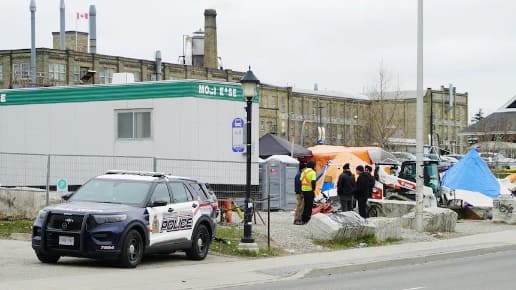
Look closely at the reality of the Kitchener site above. This image captures the exact structural friction point: temporary tarps and tents hemmed in by steel security fences, flanked by a police cruiser, sat directly against an industrial backdrop where major public transit infrastructure is slated to rise. The state is fully mobilized here, deploying law enforcement, concrete blockades, and municipal machinery. Yet, this entire multi-million-dollar enforcement perimeter represents a failure to execute the one measure that actually solves the crisis: permanent, dignified, low-income housing.
The Financial Paradox: Funding Growth vs. Social Stagnation
To understand how deep this systemic failure runs, we have to look past the political theater and analyze the fiscal policy. The state claims it is throwing everything it has at the problem, but an objective analysis of public spending reveals a massive misallocation of resources.
| The Reactionary Spend (Management) | The On-the-Ground Reality | The Structural Disconnect |
|---|---|---|
| $4 Billion total government funding poured into Ontario’s homelessness ecosystem in 2025. | 85,000+ Ontarians remained completely unhoused in 2025. | Total homelessness jumped 7.8% in one year, and nearly 50% since 2021. |
| $700 Million allocated annually by Ontario for local “homelessness prevention” and emergency hubs. | Nearly 2,000 active encampments documented across the province. | Inflation-adjusted provincial spending on permanent low-income housing has remained virtually flat for a decade. |
| $561 Million spent annually by the federal government via its Reaching Home strategy. | The unhoused population is disproportionately composed of Indigenous, disabled, and racialized individuals. | The Parliamentary Budget Officer (PBO) reports Canada is short by $3.5 Billion annually to cut chronic homelessness in half. |
Managing Visibility vs. Resolving Hardship
Why is the money failing to move the needle? Because the funding flows heavily into crisis management rather than crisis resolution.
When a municipality clears a camp, money is paid to private demolition contractors, municipal cleanup crews, and overtime police details. When an emergency shelter is opened, millions flow to temporary facilities, short-term security operations, and bureaucratic overhead. This creates a lucrative economic ecosystem centered around containment.
For the African Diaspora, this dynamic is intimately familiar. It mirrors the global patterns of “poverty reduction” frameworks that fund extensive administrative structures, surveillance, and temporary aid without ever dismantling the core economic barriers or land inequities that cause the poverty in the first place.
The Waterloo Region tried to use its municipal bylaws to criminalize survival because its transit construction schedule was slipping. But as Michael Gibson correctly noted in his landmark ruling, you cannot legally or humanely evict people from public land when the state itself has failed to provide a viable, lawful alternative.
The Akatarian Takeaway
Canada cannot build a world-class, multi-billion-dollar transit network on top of a third-world social safety net. If Ontario can seamlessly mobilize hundreds of millions of dollars for concrete, steel, and commuter convenience, the argument that it “lacks the resources” to house 30 people in Kitchener falls completely apart.
Premier Ford is threatening to weaponize the Notwithstanding Clause to override basic human rights because a constitutional ruling inconvenienced his construction deadline. It is time to stop blaming a judge, and stop blaming the 30 people sleeping in the dirt. It’s time to demand accountability from a system that treats poverty as a budget line item to be managed rather than a human emergency to be solved.