
There is an ancient rule at the foundation of every credible legal system: justice must not only be done, it must be seen to be done. A judge can be honest, brilliant, and incorruptible – and still be disqualified from a case if a reasonable observer would doubt his impartiality.
Nigerian courts have recited this principle for decades.
Which is why the estate rising in Katampe District, Abuja, matters more than any single judgment.
The Gift
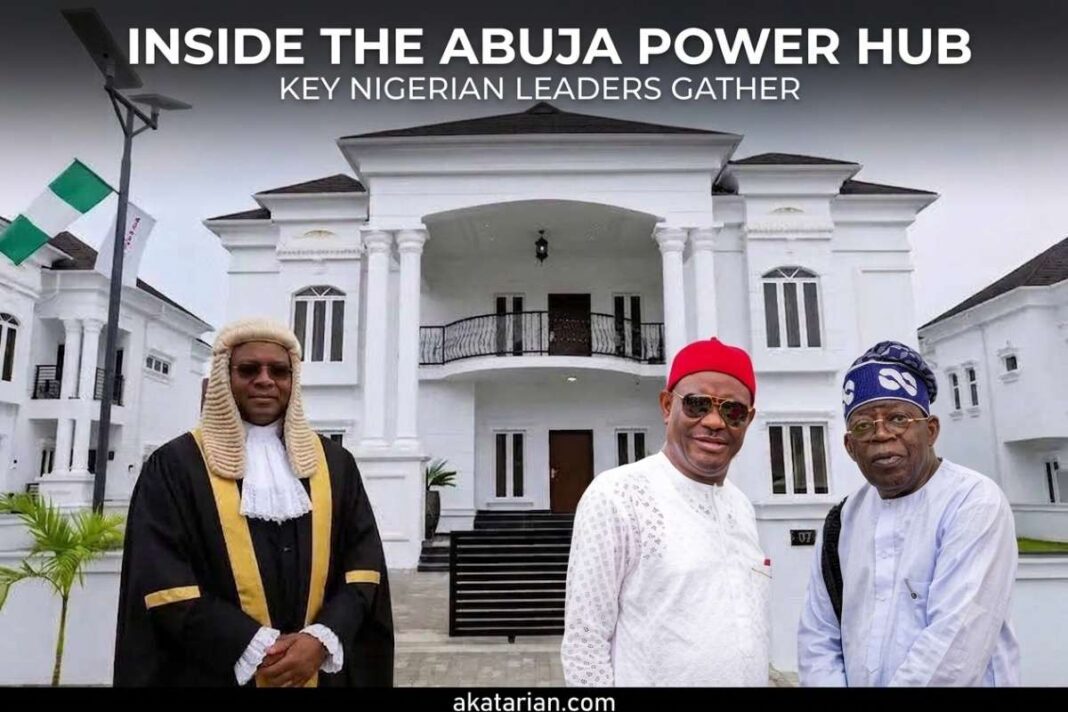
The Federal Capital Territory Administration, under Minister Nyesom Wike, has constructed 40 residential quarters for judges of the Federal High Court, the Court of Appeal, and the FCT High Court. President Bola Tinubu has commissioned the completed batches, through his Attorney-General, Lateef Fagbemi. Wike has gone further: he is seeking presidential approval to convert the quarters to owner-occupier arrangements, meaning the judges will not merely live in the houses. They will own them. He has also pledged another 20 units before the end of Tinubu’s first term, and confirmed that heads of courts will retire with the mansions built for them, title documents issued in their personal names.
Strip away the language of “welfare” and describe the transaction plainly: a serving politician, whose government is a party or interested party in cases before these same courts, is transferring multi-million-naira real estate into the personal ownership of sitting judges, months before a general election those judges will help decide.
If a private litigant did this, we would have a single word for it.
The Objections and the Defense
The alarm has not come from opposition politicians alone. The outgoing President of the Nigerian Bar Association, Afam Osigwe, SAN, warned that politicians building houses or gifting cars to judges creates a corrosive perception of closeness between the executive and the judiciary that undermines public trust.
Human rights lawyer Femi Falana, SAN, went further, threatening legal action and arguing that judicial autonomy was constitutionalized precisely so judges would never need to collect houses and cars from the executive; critics of the scheme have described it as tantamount to a bribe. Analysts have asked openly whether executive funding of lavish judicial accommodation is compatible with separation of powers at all.
In fairness, the government’s defense deserves a full hearing. Wike insists the project is FCT infrastructure like any other. The Federal Capital Development Authority builds public buildings, courts included and Wike notes that previous executive-funded judicial projects drew no accusations of capture. He accuses the NBA of hypocrisy, pointing out that state governments have long funded Bar activities without anyone declaring the lawyers compromised.
President Tinubu has asked why nobody levels the same charge at staff quarters commissioned for university lecturers. And beneath it all sits an uncomfortable truth the critics must answer: Nigerian judges are poorly paid relative to the stakes they adjudicate, and a judge who cannot afford security and decent housing is vulnerable to worse offers than a government quarters.
These are serious arguments. They are also beside the point. Lecturers do not rule on whether the man who built their houses remains in power. The issue has never been whether judges deserve decent housing; they do. The issue is who provides it, on what terms, and what the provider has pending in court. Judicial welfare routed through the National Judicial Council’s own budget is autonomy. Judicial welfare handed over personally by a politician at a ribbon-cutting, converted into private title, is patronage, whatever the intention.
The Questions That Demand Answers
So let us ask, on the record, the questions the architecture of this arrangement raises:
- Can a judge be seen to fairly hear a case involving the interests of the government or the political allies of the man who handed him the keys to his house?
- Why has no allocation list been published? Nigerians know 40 houses exist. We do not know which judges received them. If the scheme is innocent, the list is harmless. Publish it.
- Why owner-occupier? Official quarters revert to the state; owner-occupier converts a welfare argument into a permanent personal wealth transfer from the executive to named judicial officers.
- Which oversight body, the NJC, the Code of Conduct Bureau, has examined whether acceptance of these properties complies with the Code of Conduct for judicial officers, which restricts gifts that could be seen to influence official duties?
- Why are politically sensitive party cases in the Abuja Division repeatedly assigned to the same small set of judges out of twelve? The PDP formally petitioned the Chief Judge over this pattern, labelling three courtrooms, including Justice Peter Lifu’s, “Courts of Particular Concern.” The petition was ignored. Who decides assignments, and by what criteria?
- What consequence follows when a judge defies a superior court? The Court of Appeal found that Justice Lifu delivered his party-deregistration judgment in open disobedience of its stay order, describing the conduct as “judicial rascality.” The ADC has petitioned the NJC. If the answer is nothing, every politician in Nigeria has just been shown the price of a favorable nullity: zero.
- And the question that contains all the others: in 2027, when election petitions arrive, as they always do, before judges housed by one side of the contest, why should the losing side accept the result?
We Have Seen This Film Before
None of this is speculation about how judicial capture works. It is memory. In 1993, Justice Bassey Ikpeme granted Arthur Nzeribe’s Association for a Better Nigeria a late-night injunction against the June 12 election, the most consequential ex parte order in our history, and the opening act of a constitutional catastrophe. In 2019, Chief Justice Walter Onnoghen was removed by executive maneuver weeks before a presidential election over which he would have held final judicial authority. In 2020, the Supreme Court declared Hope Uzodinma governor of Imo State after he had placed fourth in INEC’s declared results, a judgment that turned “go to court” from taunt into strategy. In 2023, the same court affirmed Ahmed Lawan as a senatorial candidate in a primary he did not contest. And in 2026, a Federal High Court judge attempted to deregister the entire opposition coalition’s platform eight months before a general election, on a suit the Court of Appeal found was filed by plaintiffs with no standing at all.
Each episode has its defenders and its technicalities. Together, they form a pattern: when Nigerian politicians cannot win at the ballot, they litigate, and too often, the bench cooperates.
Why This Decides 2027
Here is the factor too many election observers miss. Nigerian elections are not concluded on election day; they are concluded at tribunals. After 2023, the presidency itself and a substantial share of governorships were effectively confirmed or settled in courtrooms, not polling units. The judiciary is not an observer of Nigerian elections. It is the final constituency, the one whose vote counts last and cannot be overridden.
That is precisely why the Court’s independence is not a lawyers’ debate. A judiciary the public believes is bought converts every close election into a legitimacy crisis, every tribunal ruling into a provocation, and every “go to court” into an insult. INEC can conduct a flawless poll and still deliver a failed election if the courts that certify it are not trusted. Conversely, the Court of Appeal’s reversal of the ADC deregistration shows what a credible bench buys the nation: a constitutional crisis averted in a single unanimous judgment.
The judiciary’s immune system worked once this July. The mansion project is a test of whether we are strengthening that immune system or quietly buying the doctors.
The Demand
This publication is not accusing any named judge of collecting a house in exchange for a judgment. We do not have to. The point of the “seen to be done” standard is that the public should never be forced to guess. So the demand is simple, and we put it to the FCT Administration, the FCDA, the National Judicial Council, and the leadership of the affected courts: publish the allocation list. Name the beneficiaries of the Katampe quarters. Disclose the terms of the owner-occupier conversion. Let every litigant walking into an Abuja courtroom in 2027 know exactly what their judge has received, and from whom. If the houses are truly innocent, sunlight costs nothing. If the list stays hidden, Nigerians are entitled to draw the conclusion that hidden things invite. Justice must be seen to be done. Right now, in Abuja, it is the houses that are seen and the justice we are asked to take on faith.