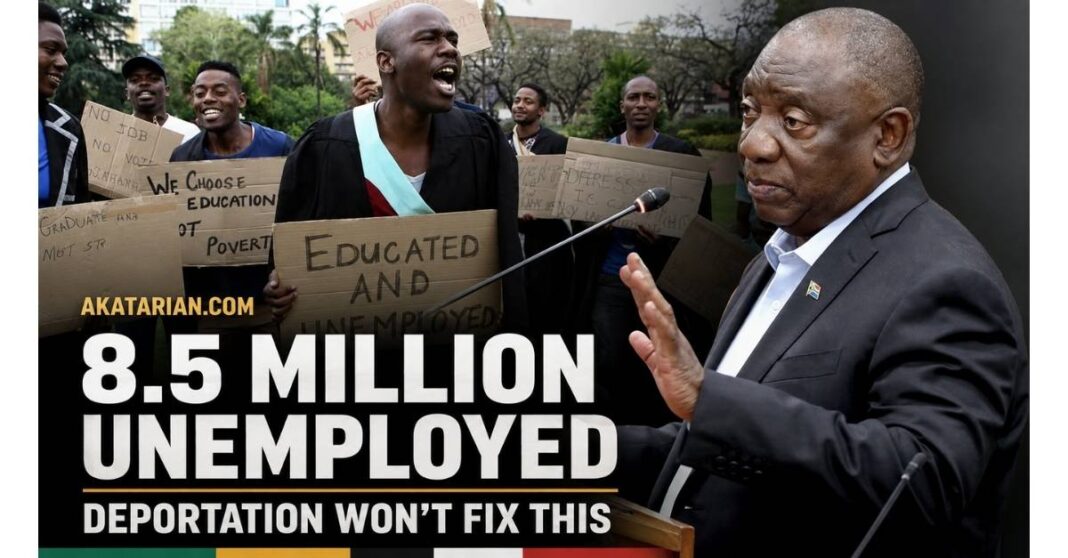

More than 178,000 African migrants have left South Africa since late May – deported, repatriated, or driven out by protest movements that promised their departure would open jobs for South Africans. On Tuesday, Statistics South Africa published the first labour data of the exodus era.
Unemployment went up.
The official rate rose from 32.7% in the first quarter to 33.6% in the second, the highest reading since 2022, with the number of unemployed South Africans climbing by 345,000 to 8.5 million. Employment fell in seven of the ten sectors Stats SA tracks. Among people aged 15 to 34, unemployment now stands at 47.4%: five million young people without work.
These are the numbers the migration debate has to answer to. Because if the removal of foreign workers were the mechanism it is claimed to be, vacate a job, transfer it to a citizen, the second quarter should have been the moment the machine started working. Instead, the labour market absorbed almost none of the 329,000 people who entered it looking for work.
What the data actually shows
The Quarterly Labour Force Survey for Q2 2026, released August 11, records a labour market that stood still while need grew. Total employment fell by 16,000 to 16.7 million. The formal sector shed 41,000 jobs; the informal sector, where undocumented migrants have historically been concentrated, added 34,000. The Western Cape lost 48,000 jobs, Gauteng 22,000, North West 15,000.
The headline rate understates the crisis. Stats SA’s broader measures put the combined rate of unemployment and the potential labour force (LU3) at 43.8%, and the fully expanded composite (LU4), adding time-related underemployment, at 46.3%. Nearly half of South Africa’s extended labour force is either jobless, underemployed, or has stopped believing that searching will produce anything.
One number deserves particular attention: discouraged work-seekers fell by 227,000. That is not good news dressed as bad. It means hundreds of thousands of people who had given up re-entered the search, quite possibly because they were told jobs were about to open up, and the economy had nothing for them. The labour force grew by 329,000; employment grew by none of it.
The 178,000 test
The scale of the departures is not in dispute. Authorities in migrants’ home countries report more than 115,000 returns to Zimbabwe since late May and more than 56,000 to Malawi, with Nigeria, Ghana, Mozambique and Lesotho each recording over a thousand. South Africa itself says roughly 19,000 people have been formally deported since April; the large majority of departures were people who left under repatriation programmes or fled anti-migrant violence – door-to-door campaigns in which rights groups say homes and businesses were burned, including those of legal residents.
Two things must be said plainly, and Akatarian will keep saying both.
First: South Africa is entitled to enforce its immigration law. No state is obliged to tolerate unlawful residence or unlawful employment, and conceding that point costs the pro-migrant case nothing. President Ramaphosa’s promises of border technology, immigration courts and penalties for employers who hire without documents are, on their face, ordinary statecraft.
Second: enforcement is not an employment policy, and the arithmetic never supported treating it as one. South Africa’s 2022 census counted 2.4 million foreign nationals in a population of 62 million – every legal resident, work-permit holder, refugee and undocumented person combined. The unemployed number 8.5 million. Even under the fantastical assumption that every foreign national held a job and every one of those jobs transferred seamlessly to a citizen, the problem would remain unsolved by millions. The structural gap is not migrant-shaped.
The honest caveat – and why it sharpens the story
Rigour requires acknowledging what this quarter’s data can and cannot prove. The exodus accelerated from late May; the survey covers April through June. Q2 therefore captures only the opening weeks of the departures. Anyone claiming this data definitively refutes the jobs-transfer thesis is overreaching, just as anyone who promised immediate gains was overreaching in the other direction.
That makes the third-quarter survey, due in November, the cleanest natural experiment South Africa has run on this question in years. July through September will be the first full quarter after the largest migrant departure from the country in recent memory. If unemployment falls meaningfully and the gains concentrate in agriculture, construction, hospitality and domestic work – the sectors migrants dominated – the enforcement lobby will have evidence. If unemployment holds above 33% after 178,000 departures, the “foreigners are taking the jobs” explanation collapses on its own terms, measured by the state’s own statistician.Akatarian will be watching that release, and we commit now to reporting the result whichever way it cuts.
The questions that decide it
Between now and November, the reporting burden falls on specifics, not slogans. The questions this publication is putting to Statistics South Africa, the Department of Employment and Labour, Home Affairs, unions, employers and migrant-worker associations:
How many vacancies created by departures have been filled by South African citizens, and in which sectors?
Where positions remain unfilled, is the barrier wages, skills, or location?
Have wages moved in migration-intensive sectors, the clearest signal of genuine labour shortage?
Farms in Limpopo, restaurants in Johannesburg, construction sites in Durban: are they hiring locally, raising pay, or cutting output?
And what do the full QLFS tables show for Black women and for youth, the two groups every government since 1994 has promised to reach first and reached last?
Institutional incentives cut both ways here, and readers should weigh them. Anti-migrant movements need unemployment to be a foreigner problem; the alternative is admitting the campaign burned people’s homes for nothing. Employers who relied on migrant labour need it to be a skills problem; the alternative is admitting they built business models on wages citizens cannot live on. Neither claim should be taken on faith. The Stats SA labour series, collected quarterly, methodologically consistent, indifferent to politics, is the referee.
The larger pattern
South Africa’s jobless rate has sat above 30% for more than five years, peaking at a record 35.3% in late 2021, long before the current enforcement wave, through periods of higher and lower migration alike. The causes economists cite are stubbornly domestic: electricity and logistics failures, anaemic investment, an education system that leaves millions unemployable in a modernising economy, and labour-market rigidities that make formal hiring expensive.
None of that fits on a placard. “Foreigners are taking your jobs” does. And that is the pattern the diaspora should recognise, because it travels: when a government cannot solve a structural problem, the politically cheapest move is to find someone the problem can be blamed on, preferably someone who cannot vote.
Zimbabweans in Johannesburg, Nigerians in Cape Town, Malawians in Durban did not cause a 33.6% unemployment rate. The question the next two quarters will answer, in the government’s own numbers, is whether their absence fixes anything at all.
Eight and a half million people are waiting for that answer. They deserve better than a slogan.