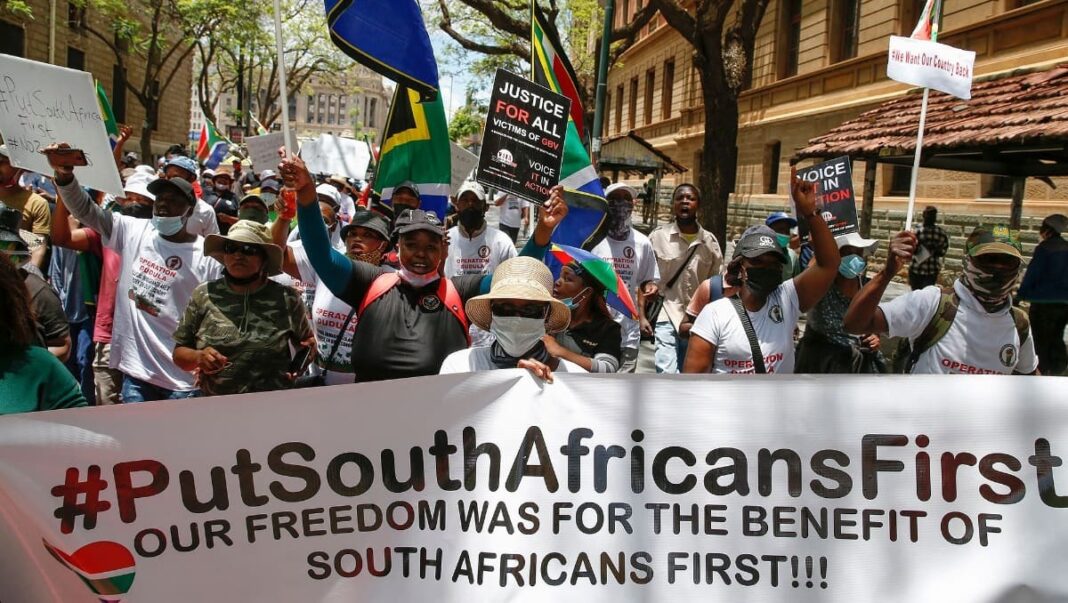

When a Black-led democracy spends three decades blaming foreigners for failures it had the power to fix, the issue is no longer just prejudice. It is political evasion.
South Africa’s xenophobia problem is usually discussed as if it were an unfortunate side effect of poverty. That is too soft.
What we are looking at is something more revealing and more dangerous: a Black-led state, almost 32 years after democratic transition, still struggling to govern well enough to keep its own citizens from turning on poorer, weaker Africans. South Africa held its first democratic all-race election on April 27, 1994, and Nelson Mandela became president in May 1994. As of April 23, 2026, that is nearly 32 years of post-apartheid, Black-led rule.
That timeline matters because it destroys a convenient excuse.
Yes, apartheid left a brutal inheritance. Yes, white minority rule engineered dispossession, inequality, labour exclusion, and spatial misery on a massive scale. But after nearly three decades in power, South Africa’s governing class cannot keep treating the present collapse as though it is still an untouched handover file from 1994. Nelson Mandela, Thabo Mbeki, Jacob Zuma, and Cyril Ramaphosa all governed within that post-apartheid order. The state has changed hands. Accountability must follow power.
And yet, instead of a sustained national culture of inward political reckoning, South Africa has repeatedly produced a more convenient reflex: blame foreigners.
The Outsider Is the Easiest Target
This is not uniquely South African. It is not uniquely Black. It is not even uniquely African.
It is human.
When people feel economically trapped, politically humiliated, and socially abandoned, they often do not attack the most causally responsible actors. They attack the nearest vulnerable group. Sociology has a name for part of this: relative deprivation. People do not respond only to raw poverty; they also respond to the feeling that they were promised dignity, opportunity, and belonging, then denied all three. Under those conditions, outsiders become easy symbolic culprits. The UN special rapporteur on racism has described how xenophobia and racialized exclusion often intensify where insecurity, nationalism, and political manipulation converge.
That is why the standard line – foreigners are taking jobs, crowding clinics, committing crimes, and ruining neighbourhoods – keeps resurfacing even when the state’s own failures are more structurally important.
Foreigners do not create 30-plus percent unemployment. Foreigners do not engineer state incapacity. Foreigners do not hollow out Eskom, normalize corruption, or sabotage municipal competence. Foreigners did not capture the post-apartheid state. But they are more exposed than ministers, easier to harass than party bosses, and safer to blame than the ruling class.
That is the underbelly.
Three Decades of Rule, Three Decades of Excuses
South Africa’s official unemployment rate was 31.4% in the fourth quarter of 2025, according to Statistics South Africa. That is already catastrophic. In practice, the social reality feels worse because underemployment, youth joblessness, and informal fragility amplify the pain far beyond the headline figure.
Xenophobia Is Not a Side Story. It Is a Symptom
Human Rights Watch’s recent reporting is blunt: anti-immigrant vigilante groups such as Operation Dudula and March for March have blocked migrants from accessing public health facilities and public education, despite South Africa’s constitutional guarantees. HRW has also documented how anti-migrant rhetoric by public figures and organized groups fuels intimidation and exclusion.
This is not random street anger floating in isolation from politics. It is a social mood repeatedly sharpened by political language, policy posturing, and weak enforcement.
Xenowatch’s long-running monitoring shows how entrenched the pattern has become. Its 2021 violence report recorded 873 incidents, 612 deaths, and 122,298 displaced persons, while later reporting for 2022–2024 found xenophobic discrimination remained persistent and widespread, with organized anti-migrant vigilante activity growing and KwaZulu-Natal, Gauteng, and the Western Cape remaining heavily affected.
Why Foreigners Carry the Blame
Because they are visible. Because they are less protected. Because they are easier to punish than the political class. Because blaming them lets failing leaders survive another election cycle.
Human Rights Watch warned in 2023 that officials’ scapegoating of foreigners had pushed many South Africans to blame migrants for economic suffering. The UN in South Africa said in August 2025 that vigilantism and xenophobic intimidation have no place in a constitutional democracy, explicitly rejecting the logic that migrants should be harassed for broader governance failures.
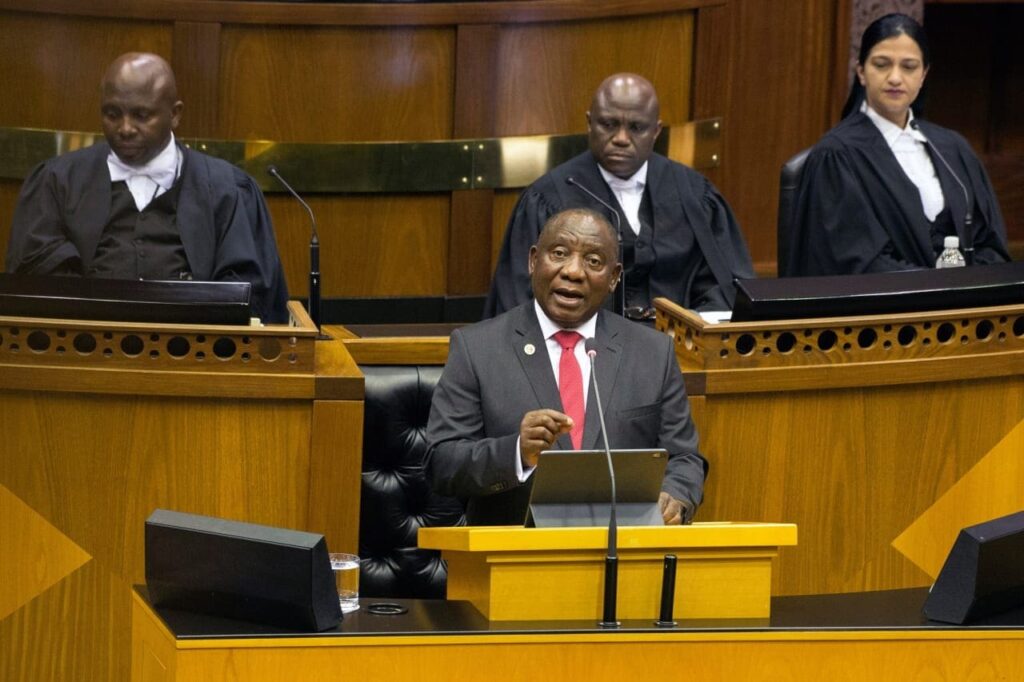
This is how it works in practice:
A government fails to produce jobs.
A city fails to manage housing.
A clinic system is strained.
A police system is distrusted.
A society is angry.
Then someone says: The foreigners did it.
That claim is emotionally convenient, politically profitable, and analytically lazy.
It is also a gift to incompetent elites.
Because every hour spent chasing immigrants is an hour not spent interrogating procurement abuse, policy stagnation, cadre deployment, local government decay, school dysfunction, policing failure, energy crisis mismanagement, and the long afterlife of elite impunity.
The Courts Have Been Clearer Than the Politics
In late 2025, the Johannesburg High Court ruled against Operation Dudula’s anti-migrant activities, confirming that blocking or interfering with access to healthcare and schools, threatening foreign nationals, and inciting hatred were unlawful. The case underscored how far vigilante anti-foreigner politics had moved from rhetoric into organized rights violations.
That matters because it clarifies the legal and moral point: migrants are not a valid substitute for governance.
A constitutional democracy cannot allow mobs and political entrepreneurs to decide who counts as human enough for school, clinics, safety, or dignity.
But the deeper embarrassment is this: the judiciary has had to state the obvious because too much of the political class refused to.
The Harder Diaspora Lesson
There is a temptation in African and diaspora discourse to treat anti-Black exclusion in the West as a unique moral evil while treating anti-foreigner exclusion inside Black societies as an unfortunate misunderstanding.
No. Both deserve scrutiny.
When Western politicians blame immigrants for wages, crime, or cultural breakdown, we rightly call it scapegoating. When South Africans do the same to other Africans, many people suddenly become sociologically cautious and politically evasive. That double standard is part of the problem.
The same broader human logic appears elsewhere too. Groups under pressure often externalize blame rather than confront internal dysfunction. In the United States, different communities blame immigrants, minorities, “coastal elites,” or welfare recipients. In Europe, migrants and Muslims often become the vessel for national anxiety. In parts of Africa, foreigners become the stand-in for policy failure.
What South Africa Is Really Telling Us
South Africa is telling us that liberation movements can become governing machines without becoming governing successes.
It is telling us that post-colonial grievance can turn into a permanent alibi.
It is telling us that people who were once oppressed do not become immune to oppressing others.
And it is telling us that when a state repeatedly fails to deliver material progress, it will be tempted to redirect popular fury toward those with the least institutional protection.
That is why xenophobia in South Africa should not be treated as an unfortunate footnote to unemployment. It is one of the clearest signals that the post-apartheid promise has been mismanaged, diluted, and politically weaponized.
The Mirror Is the Threat
The real danger of South African xenophobia is not only the violence done to migrants.
It is the lie it allows a nation to tell itself.
That lie says the crisis came from outside.
That lie says the state is failing because foreigners arrived.
That lie says poor Africans crossing borders are more powerful than the politicians, parties, and institutions that have run the country for nearly 32 years.
That is nonsense.
And until that nonsense is confronted, foreigners will remain convenient targets, elites will remain insufficiently accountable, and South Africa will keep mistaking misdirected anger for political clarity.
The mirror, not the migrant, is the real threat.