
For years, Nigerians feared the thug at the polling unit.
The man with the gun.
The convoy in the night.
The ballot box snatcher.
Now imagine something worse: no snatching, no chaos, no dramatic violence on camera, just fake ballots quietly entering the process under the cover of legal wording.
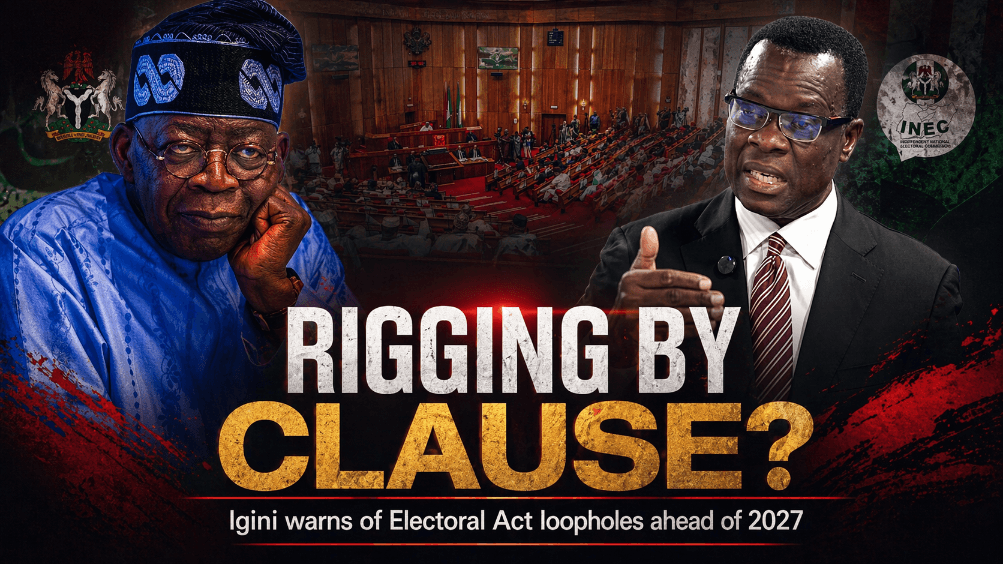
That is the shock former INEC Resident Electoral Commissioner Mike Igini is forcing Nigerians to confront. His warning is not about rumor or conspiracy theory. It is about what he says is already sitting inside the Electoral Act, 2026: clauses that could widen discretion, weaken accountability, and make rigging less crude, but more respectable. Or at least more deniable.
Igini’s language was not subtle. If the provisions he identified are not repealed, he warned, “the integrity of the 2027 election will be in flames.” That is not casual commentary. That is a former top election official effectively saying the legal architecture of the next election may already contain its own sabotage points.
The real horror is not ballot snatching. It is ballot laundering.
The center of the controversy is Section 63. On paper, the law says a ballot paper without the Commission’s official mark should not be counted. But it then creates an opening: if the returning officer is satisfied that the ballot paper came from the ballot book used for the polling unit, the ballot can still be counted “notwithstanding the absence of the official mark.” That is the kind of legal drafting that sounds technical until you realize what it means in practice: discretion. And in a weak system, discretion is where manipulation goes to hide.
Igini’s warning lands because he is not speaking like an armchair activist. He is speaking as someone who has administered elections across Nigeria. His argument is brutal in its simplicity: once you allow ballots without official marks to be counted, politicians with access to ballot identifiers or insiders in the chain can try to flood the system with their own papers and then pressure compromised officers to be “satisfied.” That is not just a loophole. That is a mechanism.
Put differently: yesterday’s rigging required visible criminality. Tomorrow’s rigging may require only legal ambiguity plus state power.
Nigerians are worried because they have seen this movie before
This fear did not emerge in a vacuum. Earlier this year, lawmakers touched off national outrage when they moved to make electronic transmission of results optional rather than mandatory. The backlash was immediate. Civil society groups, labour voices, lawyers, and ordinary Nigerians pushed back hard enough that the Senate reversed course and backed real-time electronic transmission after the outcry. That episode mattered because it confirmed public suspicion: many Nigerians believe powerful actors are still scanning the law for pathways to control outcomes before a single vote is cast.
The other clauses deepen the distrust
Igini also pointed to Sections 137 and 138. Section 137 says it is not necessary to join certain electoral officers in an election petition. Section 138 says that an act or omission contrary to INEC directives is not, by itself, enough ground to question an election unless it also violates the Act. For reformers, that creates a dangerous mix: fewer direct consequences for officers and less legal force for INEC’s own operational rules. In plain English, it can become easier to disobey process and harder to make that disobedience fatal to an election result.
Igini is arguing that the law may be reducing the cost of misconduct and expanding the room for excuse-making. In a country where elections often end in litigation, that is gasoline near a live wire.
Why this lands differently in 2026
If Nigeria were booming, competent, and visibly improving, some of this anxiety would still exist, but it would not burn this hot. The outrage is sharper because the political mood is already sour.
Since President Bola Tinubu took office in May 2023, his government’s reforms have been defended as painful but necessary. Reuters reported in 2024 that the reforms helped trigger Nigeria’s worst cost-of-living crisis in decades, with subsidy changes, currency weakness, and price shocks hitting ordinary households hard. In January 2026, Reuters also reported that labour groups said the reform drive had eroded incomes and pushed millions into hardship, even as officials argued that macro indicators were improving.
The World Bank’s April 2026 Nigeria Development Update said poverty had increased and remained widespread due to inflation and falling real incomes, while multiple reports on that update said the poverty rate reached 63% in 2025, affecting an estimated 140 million Nigerians. Meanwhile, the National Bureau of Statistics reported headline inflation at 15.38% in March 2026. Even where some macro numbers have improved, household pain has not magically disappeared. Nigerians do not eat “reform narrative.” They eat food, pay transport, buy diesel, and endure blackouts.
That is the political problem for the ruling class. If living conditions had improved dramatically, those achievements could have served as campaign assets. Reliable power supply could be marketed. Currency stability could be marketed. Lower food costs could be marketed. Broad-based relief could be marketed. But where hardship remains the lived reality, political strategists become more tempted to rely on structural advantage instead of public gratitude. That is an inference from the political context, but it is exactly why legal loopholes provoke such fear.
All eyes are on Tinubu – and that is the uncomfortable truth
With the next general election set for 2027 and Tinubu widely expected to seek a second term, every electoral amendment is now read through the lens of incumbency. That is not paranoia. Incumbents everywhere prefer uncertainty that they can manage over transparency they cannot control. And in Nigeria, where institutions are often weaker than personalities, the fear is always the same: who benefits from ambiguity?
The underbelly Nigerians should not ignore
The old form of rigging was messy.
The new fear is cleaner.
Less snatching. More drafting.
Less violence in public. More loopholes in print.
That is what makes this moment dangerous.
If a fake ballot can be argued into legitimacy by the “satisfaction” of an officer, if disobeying INEC’s directives is not enough on its own to sink an election, and if the officers at the center of disputed conduct are easier to keep at procedural distance, then the struggle for electoral integrity is no longer only at the polling unit. It is already inside the statute book.
Nigeria should not wait until 2027 to discover whether these warnings were exaggerated. By then, the lawyers will feast, the losers will cry foul, the winners will preach peace, and citizens will once again be told to move on.
That is the scam Nigerians are tired of: suffering first, doubting later, and being asked to clap for a democracy they no longer trust.
If the law contains cracks big enough for riggers to walk through, then fixing them is not opposition politics. It is democratic self-defense.