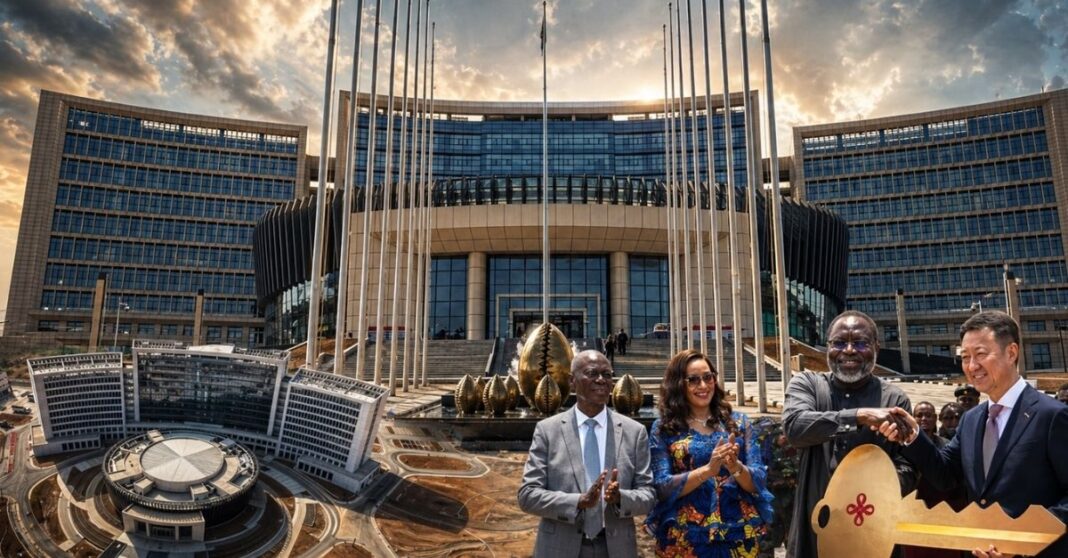

The $56 million China-funded ECOWAS headquarters is being celebrated as a diplomatic milestone. But for a regional bloc facing legitimacy crises, Sahel exits, and rising external competition, the deeper question is whether West Africa can defend the invisible architecture of its own power.
The House That China Built
On a humid morning in Nigeria’s capital, West Africa’s most important regional institution received the keys to its new home.
There were flags, polished shoes, careful speeches, diplomatic smiles, and the familiar language of partnership. Officials praised friendship. Cameras captured the handshakes. Before the assembled dignitaries stood the new ECOWAS headquarters complex in Abuja, a modern facility built to house the ECOWAS Commission, the ECOWAS Parliament, and the Community Court of Justice in one location.
Chinese state media described the project as a China-aided headquarters complex and said it was handed over to ECOWAS on April 28, 2026, marking a milestone in China-Africa relations and regional integration. Nigerian and regional reports placed the value of the project at roughly $56.5 million funded by the Government of the People’s Republic of China.
The official story is simple: ECOWAS needed a modern headquarters. China funded and built one. The new complex is expected to improve coordination by bringing scattered ECOWAS institutions into one site. Reports say the facility includes office blocks, an 800-seat conference centre, clinic, daycare, gyms, restaurants, archives, security quarters, and parking for hundreds of vehicles.
But the image carries another meaning.
A foreign power has built the house where West Africa’s regional decisions will be made.
That does not automatically make China guilty of anything. It makes China strategic.
The harder question is whether ECOWAS – already weakened by coups, legitimacy disputes, levy compliance problems, and the formal exit of Mali, Burkina Faso, and Niger – understands the symbolism of accepting a foreign-built headquarters at the very moment it is trying to defend regional sovereignty.
This is not merely an infrastructure story. It is a sovereignty story. And sovereignty is not a speech.
It is an audit.
A Gift, Not a Loan – But Gifts Have Gravity
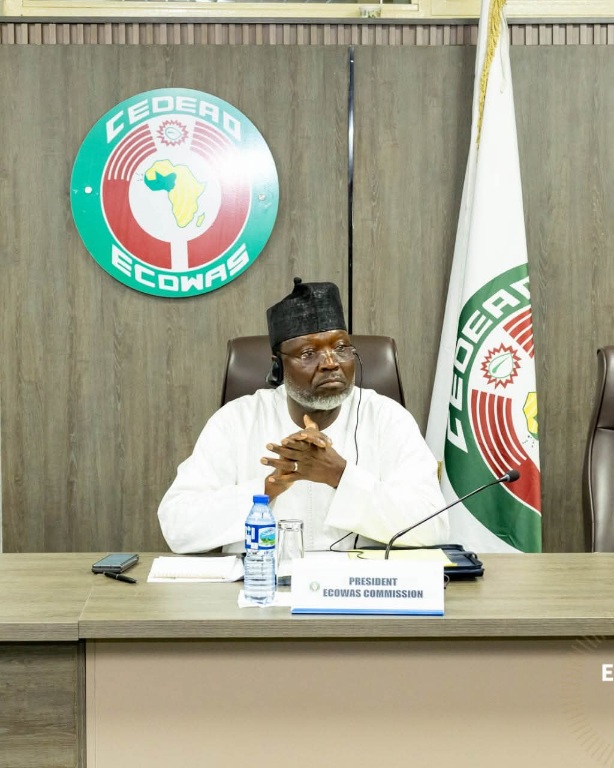
One detail matters: this headquarters is presented as a grant, not a loan.
That distinction is important. This is not the standard “debt trap” story. ECOWAS is not being asked to repay a Chinese loan for the building. The project has been described as funded by China and delivered as a China-aid project.
But debt is not the only form of leverage.
There is financial debt.
There is diplomatic debt.
There is symbolic debt.
There is institutional dependence.
And there is gratitude that quietly becomes political posture.
China’s advantage is that it understands something many African leaders still treat casually: power is not only exercised through military bases, sanctions, loans, or trade deals. Sometimes power is exercised by building the room where other people gather to discuss their future.
That is the genius of infrastructure diplomacy. It is visible, durable, flattering, and difficult to criticize without sounding ungrateful.
A gifted headquarters is not just a building. It is a message.
It says: when West Africa needed a modern institutional home, China delivered.
That message will outlive the ribbon-cutting ceremony.
The Shadow of Addis Ababa
To understand the quiet anxiety around Abuja, one must look east to Addis Ababa.
The African Union headquarters in Ethiopia was also built and gifted by China. In 2018, Le Monde reported allegations that data from the Chinese-built AU headquarters had been transferred nightly to servers in Shanghai for several years. China denied the allegations, and AU officials also rejected or downplayed the claims. The Council on Foreign Relations later analyzed the controversy as significant because it highlighted Africa’s geopolitical importance to China and the cybersecurity risks surrounding strategic infrastructure.
That history must be handled carefully.
There is no public evidence that the new ECOWAS headquarters has been compromised. There is no responsible basis for claiming that China has bugged the Abuja complex or installed hidden backdoors.
But the Addis Ababa controversy changed the standard of care.
After that episode, no African regional institution should move into a foreign-built diplomatic facility without publishing clear answers on cybersecurity, server architecture, communications systems, access control, surveillance infrastructure, and post-handover maintenance.
Trust is not a cybersecurity policy.
Gratitude is not a security protocol.
A handshake is not an audit.
The $25 Million Question
There is another issue ECOWAS should clarify: the cost trail.
In 2018, ECOWAS announced that it had signed a Memorandum of Understanding with China for the construction of a new headquarters building, describing the project as a $31.6 million grant from the Chinese government. Africanews and other outlets reported the same figure at the time.
Yet the 2026 handover reports place the completed project at about $56.5 million to $56.57 million.
That discrepancy may have an innocent explanation. The project scope may have expanded. New facilities may have been added. Construction costs may have risen. Exchange rates may partly explain the difference. Early figures may have been preliminary.
But that is exactly why ECOWAS should explain it.
A regional body that speaks for hundreds of millions of West Africans should not leave citizens guessing about the cost evolution of its most symbolically important building.
What changed between the original grant figure and the final reported value?
Were additional facilities added?
Were digital systems, surveillance systems, conference technology, or maintenance arrangements included in the later figure?
Who approved the changes?
Were member states briefed?
Is the full agreement public?
These are not anti-China questions.
They are governance questions.
The Invisible Building Inside the Building
The visible headquarters is made of concrete, glass, steel, offices, halls, and ceremonial spaces.
But the more important building is invisible.
It consists of fiber networks, server rooms, conference systems, interpretation equipment, surveillance infrastructure, access controls, routers, data storage systems, cybersecurity protocols, backup systems, and maintenance channels.
That is where sovereignty lives now.
In the age of silicon, a headquarters is not merely a physical address. It is a nervous system. Whoever designs, installs, maintains, or fully understands that nervous system may possess forms of access more valuable than any ceremonial plaque.
Again, this does not mean China has compromised anything.
It means ECOWAS must prove that its systems are independently secured.
The question is not whether China should be trusted or distrusted emotionally. Serious institutions do not build sovereignty on emotion. They build it on verification.
If ECOWAS wants public confidence, it should disclose whether an independent cybersecurity and technical audit was conducted before handover. It should clarify who supplied the communications infrastructure, who controls the network architecture, who has maintenance access, and whether any foreign contractor retains technical support privileges inside the building.
That is basic institutional hygiene.
The Fiscal Paradox
The most uncomfortable part of the story is that ECOWAS is not a beggar institution.
The bloc has a funding mechanism: the Community Levy, a 0.5 percent tax imposed on goods imported from outside ECOWAS member states. ECOWAS parliamentary sources describe the levy as contributing between 70 and 90 percent of the ECOWAS budget.
This makes the headquarters question more complicated.
West Africa has a mechanism to finance regional institutions, yet its most visible symbol of regional power has arrived as a gift from an external power.
This is not simply poverty.
It is a failure of collective seriousness.
ECOWAS and its institutions have repeatedly faced concerns over levy remittances and member-state compliance. BusinessDay reported in 2024 that poor compliance with levy payments had posed risks to the bloc’s operations, citing ECOWAS finance officials and noting that the levy constitutes the overwhelming share of annual funding.
That is the deeper indictment.
It is easier to accept a gleaming headquarters from Beijing than to enforce levy discipline, confront arrears, and build a regional capital project through African fiscal solidarity.
China did not force ECOWAS to accept the building. China offered what serious powers offer: assistance that also advances interest.
The scandal is not that Beijing knows its interests.
The scandal is that African institutions often behave as if they do not know theirs.
ECOWAS at Its Weakest Moment
The timing makes the optics worse.

This headquarters arrives while ECOWAS is facing one of the deepest legitimacy crises in its history. Mali, Burkina Faso, and Niger formally exited the bloc in January 2025 after a yearlong withdrawal process. The three junta-led states formed the Alliance of Sahel States and have moved to build alternative political and security arrangements.
That rupture did not happen in a vacuum.
The Sahel has become a theatre of competing external influence. Western governments, Russia, China, Gulf actors, and regional power brokers are all maneuvering inside a fractured West African order. ECOWAS is trying to project unity while its authority is visibly weakened.
So when China hands ECOWAS a new headquarters, the image lands inside a larger struggle.
Is ECOWAS becoming more independent?
Or is it becoming another platform through which external powers compete for access to Africa’s political architecture?
The answer is not simple.
China is not the only external actor. The West has used aid, debt, military partnerships, NGOs, sanctions, trade access, and financial institutions to shape African decision-making for decades. Any African analysis that treats China as uniquely manipulative while ignoring Western influence is not analysis. It is recycled propaganda.
But acknowledging Western hypocrisy does not absolve African leaders of responsibility.
The issue is not whether China is worse than the West.
The issue is whether Africa has a doctrine for dealing with all external powers.
Right now, that doctrine is difficult to see.
China Is Doing What Serious Powers Do
There is a lazy way to tell this story: China is colonizing Africa.
That framing is emotionally satisfying but analytically thin.
China is doing what serious powers do. It is building influence. It is buying goodwill. It is creating institutional memory. It is embedding itself in the physical and symbolic infrastructure of African governance.
That is not charity.
That is statecraft.
Beijing’s model is patient and visible. It builds roads, railways, ports, stadiums, government buildings, and diplomatic facilities. It does not always need to own the institution directly. Sometimes it only needs to be remembered as the power that showed up when others were lecturing, delaying, or attaching conditions.
This is why the ECOWAS headquarters matters.
A building can become a diplomatic argument.
Every meeting held there becomes part of the memory of Chinese assistance. Every visitor sees the infrastructure of partnership. Every future ECOWAS official works inside a facility associated with Beijing’s generosity.
That is influence without needing a formal command.
This is the politics of gratitude.
The Sovereignty Audit ECOWAS Owes West Africa
ECOWAS can settle much of the concern by publishing a clear sovereignty audit.
Not a press release.
Not diplomatic poetry.
Not another speech about cooperation.
A real audit.
It should answer:
Who designed the building’s digital infrastructure?
Who installed the communications systems?
Who supplied the servers, routers, CCTV, access-control systems, conference equipment, and translation technology?
Was an independent cybersecurity audit conducted before handover?
Which firm conducted it?
Will the report be shared with member states?
Who has maintenance access after handover?
Are any foreign contractors retained for technical support?
Where is sensitive ECOWAS data stored?
Who controls the building’s network architecture?
What exactly changed between the earlier $31.6 million figure and the later $56.5 million figure?
These are the questions a serious regional bloc should welcome.
Because suspicion grows in silence.
If everything is secure, say so. If the systems have been independently audited, publish the process. If ECOWAS controls all sensitive infrastructure, state it clearly. If maintenance has been fully localized, disclose it.
The problem is not the existence of a foreign-built headquarters.
The problem is the absence of visible institutional suspicion.
Why the Diaspora Should Care
This story is not only for West Africans living in West Africa.
It is also a diaspora story.
The African Diaspora sends money home, defends African dignity abroad, carries African identity into global institutions, and often reacts emotionally when external powers humiliate or patronize the continent. But outrage is not enough.
The diaspora must become more technically literate about power.
In the 20th century, sovereignty was defended through flags, borders, armies, and liberation movements.
In the 21st century, sovereignty is also defended through procurement contracts, data centers, cloud infrastructure, digital audits, port concessions, submarine cables, surveillance systems, payment rails, telecom networks, and legal clauses buried inside “cooperation agreements.”
The next generation of African power will not be protected by slogans.
It will be protected by engineers, auditors, lawyers, cybersecurity experts, procurement specialists, investigative journalists, and policymakers who understand that the invisible architecture of sovereignty matters as much as the visible one.
That is where the diaspora can be useful.
Not as sentimental spectators.
As technical watchdogs.
The new ECOWAS headquarters may well improve efficiency. Centralizing the Commission, Parliament, and Court of Justice could reduce fragmentation and improve coordination. That official argument has merit.
But useful buildings can still carry dangerous symbolism.
Africa has seen this pattern before.
The roads are financed elsewhere.
The ports are negotiated elsewhere.
The railways are built elsewhere.
The security partnerships are designed elsewhere.
The data systems are imported elsewhere.
And now, the headquarters of regional sovereignty arrives with foreign fingerprints on the keys.
China is not Africa’s babysitter.
China is not Africa’s savior.
China is not uniquely evil.
China is a serious civilization-state pursuing its interests with patience, discipline, and memory.
The unanswered question is whether West Africa’s leaders are pursuing theirs with equal seriousness.
Because if a people cannot build the house where their future is negotiated, they should at least have the discipline to inspect every wire, every clause, every server, every camera, and every hidden cost before they call the gift a blessing.
Sovereignty is not declared at ceremonies.
It is verified.
And until ECOWAS subjects the “Eye of West Africa” to a full sovereignty audit, the building will remain what the photograph already suggests: beautiful, useful, and politically unsettling.