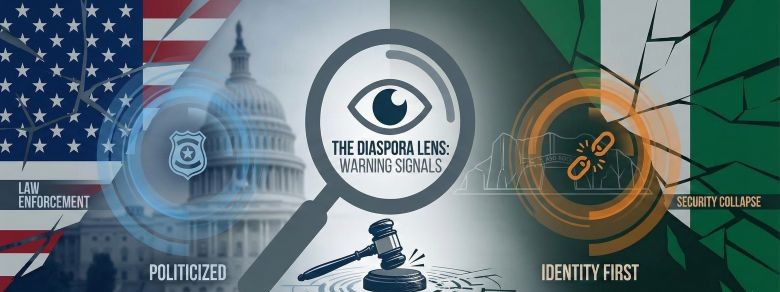

In a functioning democracy, Justice is blind. But in today’s America, Justice is increasingly checking voter registration cards and ethnic backgrounds before deciding to act. For the African Diaspora, this erosion of law enforcement neutrality isn’t just a political talking point, it is a terrifying case of déjà vu.
If you want to destroy a nation, you don’t need a foreign army. You simply need to convince the citizens that law enforcement is the enemy of their specific “tribe,” and that criminals from their own community are actually martyrs.
Once you achieve that psychological flip, the security architecture collapses.
At Akatarian, we analyze global power through the Diaspora lens. And right now, the lens is showing a red alert for the United States. The polarization of American law enforcement, where investigations are obstructed based on the identity of the suspect, is mirroring the exact trajectory that led to Nigeria’s internal security crisis.
The $250 Million Lesson: “Feeding Our Future.”
There is no starker example of this paralysis than the “Feeding Our Future” scandal in Minnesota.
Federal prosecutors allege that a network of non-profits siphoned over $250 million in federal funds intended to feed hungry children during the pandemic. Instead of buying food, the money allegedly bought Porsche sports cars, luxury real estate, and resort vacations.
But the true scandal isn’t just the theft; it is the silence that enabled it.
Reports indicate that state officials and oversight bodies saw the red flags early. They saw impossible claims of meal counts. They saw money hemorrhaging. Yet, hesitation ruled the day. Why? Because the network was deeply embedded in the Somali-American community, and officials reportedly feared that rigorous investigation would be branded as racism or “targeting.”
This hesitation is the heartbeat of institutional decay.
When “cultural sensitivity” is weaponized to shield forensic accounting, the primary victims are never the government. The victims were the Somali-American children who didn’t get fed. The victims were the honest immigrant business owners who couldn’t compete with fraudsters flush with stolen cash.
The Criminology of Excuses: “Appealing to Higher Loyalties”
To understand why this happens, we must look to Criminology.
Sociologists Gresham Sykes and David Matza famously defined “Techniques of Neutralization” the psychological methods people use to turn off their conscience so they can commit or support crimes.
The most prevalent technique in modern America is the “Appeal to Higher Loyalties.”
This is the belief that loyalty to a subgroup, be it a race, a political party, or a religion, supersedes loyalty to the law. It turns obstruction of justice into a “moral duty.”
- “I am not hiding a fraudster; I am protecting a brother against a biased system.”
- “I am not attacking the police; I am defending my community.”
When this mindset takes root, a society stops seeing crime as “wrong” and starts seeing it as “politics.” And once crime becomes political, law enforcement becomes impossible.
The Nigerian Warning: When the “Big Man” is Above the Law
For Nigerians, this American culture war is painfully familiar.
Nigeria’s current security crisis, where bandits control highways and terrorists hold territory, did not happen in a vacuum. It was birthed by decades of Selective Enforcement.
In Nigeria, the “Big Man” (a wealthy or politically connected individual) is traditionally untouchable. If a “Big Man” is investigated, his kinsmen claim their entire ethnic group is being persecuted.
- Checkpoints were compromised because soldiers were paid to look the other way for “their people.”
- Warnings about armed groups were ignored by politicians who viewed those gunmen as useful election-day enforcers.
The result? The breakdown of the monopoly on violence.
When the state is too afraid to arrest a criminal because of his “connections” or “identity,” the state loses its legitimacy. In Nigeria, that vacuum was filled by chaos. America is flirting with the same abyss.
The Crossroads
The United States possesses one of the most transparent judicial systems in history. It is a system where TD Bank can be fined billions for compliance failures, and where police officers can be, and are, jailed for misconduct. The mechanisms for justice exist.
But those mechanisms rely on public buy-in.
If Americans continue to treat every FBI raid, ICE operation, or fraud investigation as a battlefield for identity politics, they will inherit the Nigerian outcome: a society where the strong do what they want, and the weak suffer what they must.
Compassion without discernment is not activism; it is suicide.
America must relearn a hard truth that the Diaspora knows too well: You cannot have a safe community if you are busy providing “political air cover” for the criminals dismantling it from the inside.
The Akatarian Editorial Board provides incisive news and commentary on global affairs. We connect the dots between continents, empowering our community with perspective and voice.