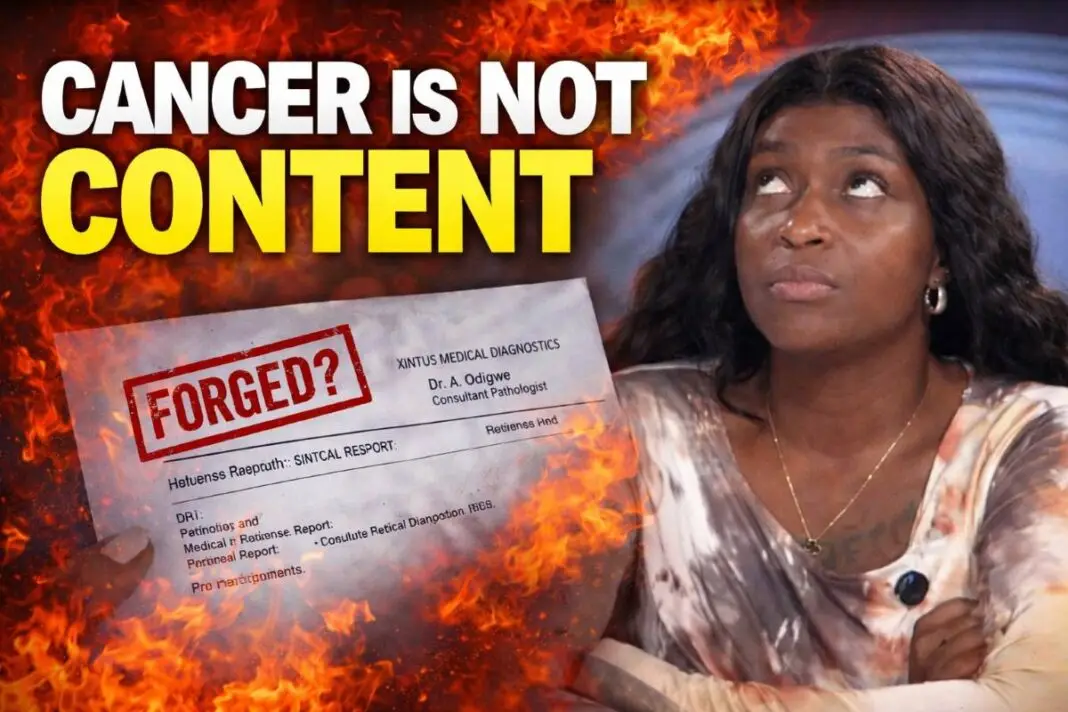

The most important issue is no longer celebrity drama, but whether disputed cancer reports and alleged document alteration can damage trust in doctors, diagnosis, and healthcare itself.
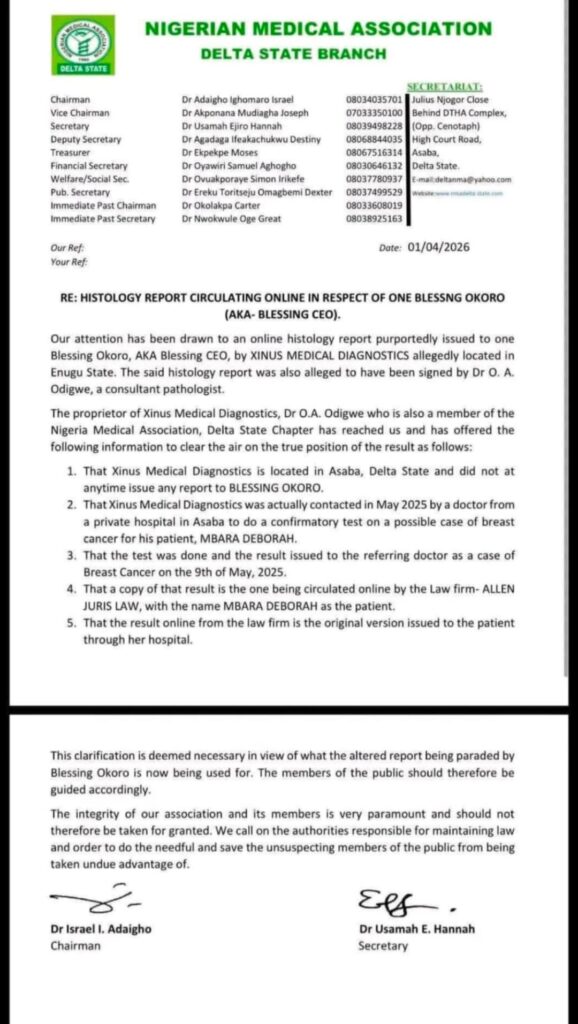
The statement attributed to the Nigerian Medical Association, Delta State Branch, may be the most consequential development in the Blessing CEO controversy. By alleging that the histology report circulating in her name was not issued to her and was, in fact, altered from another patient’s result, the statement shifts the story from gossip to something far more serious: the integrity of medicine and public trust in healthcare.
A healthcare system cannot survive without trust.
Trust in records.
Trust in diagnosis.
Trust in doctors.
Trust in evidence.
That is why the statement attributed to the Nigerian Medical Association, Delta State Branch, should be the real starting point of this story.
According to the statement circulating publicly, the histology report linked to Blessing Okoro was not issued to her. The statement further claims that Xinus Medical Diagnostics, based in Asaba, did not at any time issue such a report to Blessing Okoro, that the actual patient was Mbara Deborah, and that the version circulating online was an altered report.
If true, those claims are explosive.
Because once a medical body says a cancer-related report was altered and wrongly attached to another person, the story is no longer about personal drama. It becomes a test of whether clinical truth still has meaning in Nigeria’s public space.
That matters because medicine is a trust-based institution.
A woman who finds a lump must trust the referral process.
A patient must trust the biopsy result.
A family must trust the diagnosis enough to make life-changing decisions.
Doctors must trust that their names and reports will not be casually dragged into falsehood.
Take away that trust, and the damage is enormous.
It not only affects one controversy. It infects the wider culture. Patients become more suspicious. The public becomes more cynical. Real cancer sufferers become easier to doubt. And medical institutions begin to look like just another arena for manipulation.
That is a dangerous place for any country to be.
The global burden of cancer makes the issue even more serious. Cancer caused about 9.7 million deaths worldwide in 2022, while breast cancer alone caused about 670,000 deaths. This is not a disease that can be treated lightly, theatrically, or opportunistically. It is one of the deadliest health realities in the world.
So when cancer enters public controversy, accuracy is not optional.
The NMA statement, therefore, changes the center of gravity of this story. The question is no longer simply whether Blessing CEO made an inconsistent public claim. The deeper question is whether medical documents, diagnostic processes, and professional reputations can be publicly weaponized without swift legal and regulatory consequences.
That should concern every serious person.
Because healthcare is not only damaged by poor funding or staff shortages. It is also damaged when medical credibility becomes fragile.
And if people begin to believe that pathology reports can be altered, borrowed, reassigned, or turned into content, then the consequences go beyond this case. It erodes confidence in real labs, real referrals, real doctors, and real patients.
That is how institutional rot spreads.
For many Nigerians, the controversy also lands against a pre-existing credibility problem. In 2019, Blessing Okoro publicly apologized after falsely claiming ownership of a house that was not hers. That earlier episode does not settle the present dispute, but it helps explain why public skepticism came quickly. Trust is easier to lose than to rebuild.
Still, the central issue now is bigger than her personal history.
It is about whether the medical profession will defend its own integrity.
If the NMA statement is correct, then the matter deserves more than online reaction. It deserves investigation, regulatory action, and possible prosecution.
If the report was forged or altered, the law should act.
If a professional enabled falsehood, regulators should act.
If an institution were falsely implicated, it should defend its credibility aggressively.
Because the cost of silence is too high.
Once people stop trusting medical documents, they do not just stop trusting one influencer. They begin, slowly and dangerously, to stop trusting healthcare itself.
And when that happens, the biggest victims are not public figures.
They are ordinary patients who need a system they can believe in.