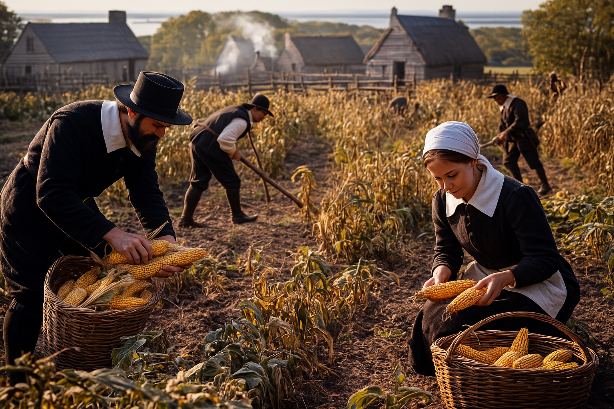

Every November, North America retells the gentle story of Thanksgiving, sharing food, giving thanks, reflecting on blessings.
But behind the familiar narrative lies a dramatic economic experiment that almost wiped out the Pilgrims…until a radical idea saved them:
Private property.
Yes, the very concept of individual land ownership became the turning point that produced the first successful harvest.
This isn’t political spin. It comes directly from the journals of Governor William Bradford, the leader of the Plymouth colony. And his testimony reads like a warning to any society flirting with enforced collectivism today.
The Pilgrims’ First System: A Failed Communal Economy
When the Pilgrims arrived in 1620, their funding contract with the London-based Merchant Adventurers required: communal farmland, shared labour, equal food distribution, no private ownership, no reward for individual effort. It was, essentially, a forced collective.
Bradford noticed immediate problems:
“The young men that were most able and fit for labour thought it some indignity to be employed in this way.”
Why? Because young, strong workers reaped the same ration as those who barely worked.Women resented caring for other men’s children. Strong farmers felt cheated. Weak farmers struggled. Everyone’s effort dropped.
Bradford wrote plainly that the system:
“Was found to breed much confusion and discontent.”
It was the Pilgrims’ first encounter with an eternal truth: When nobody owns the outcome, nobody takes responsibility.
The Starvation Years
The Pilgrims nearly starved in the first two winters. The communal system killed productivity. Food stores ran out. Rations shrank. By the spring of 1623, Bradford realized the colony would not survive another year under this model. So he made a bold move that changed everything.
1623: The Birth of Private Plots
Bradford assigned each family its own piece of land. They were free to plant, harvest, and keep whatever they produced. It was a quiet revolution. Ownership became personal. Incentives reappeared. And the results were dramatic:
“This had very good success, for it made all hands very industrious.”
Suddenly:
Families planted more
Food production skyrocketed
Women and children worked willingly
Barter and trade increased
The colony stabilized
This prosperity produced the abundant harvest that became associated with the first Thanksgiving.
Thanksgiving didn’t begin because of perfect weather or miracle crops. It began because incentives changed.
The First Thanksgiving Was an Economic Lesson
The Pilgrims gathered to give thanks not just for survival, but for clarity: The move from communal farming to private family property ended their famine. The evidence is straight from Bradford’s pen, not a modern reinterpretation. This is why Thanksgiving is not only a cultural moment, but a powerful economic case study.
Why This Story Matters for the African Diaspora Today
This lesson hits home for immigrants, diaspora families, and Africans navigating life abroad:
✔️ Ownership creates dignity. Whether land, business, or career, people thrive when they control their output.
✔️ Incentives matter across cultures. From Accra to Lagos, Toronto to Edmonton—when effort is rewarded, communities prosper.
✔️ Collectivist obligation often drains productivity.The “everyone must contribute” mentality sounds moral but often kills initiative.
✔️ Family-led production remains a timeless engine. Even today, diaspora families succeed most when each member has clear responsibility and reward.
In many ways, the Pilgrims’ 1623 revelation mirrors challenges faced by African immigrants balancing communal expectations with individual goals.
📌 Final Thought
Thanksgiving isn’t just about gratitude. It’s a reminder of a simple, global truth: When people own the outcome of their labour, they flourish. When the system punishes excellence, society collapses. William Bradford didn’t make a political statement. He simply observed human nature, and adjusted. Centuries later, the lesson still stands.