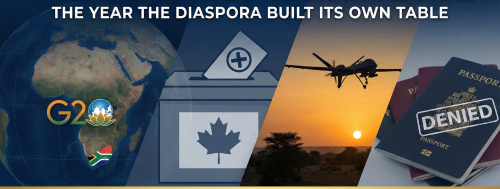

From the “April Shock” in Canada to the G20 in Johannesburg, this was the year we stopped asking for permission and started leveraging our power.
If history books look for the moment the African Diaspora stopped being a passive observer and became an active geopolitical force, they will bookmark 2025.
It was a year defined by the collapse of the “middle ground.” The comfortable assumption that the West would always be open, or that African votes were guaranteed to liberal parties, evaporated. In its place, a new realism emerged. From the boardrooms of Lagos to the ballot boxes of Brampton, 2025 was the year of bold moves, including the dramatic military intervention that closed out December.
As we close the year, Akatarian decodes the six shifts that reshaped our world and the hard data that proves it.
1. The Power Shift: G20 Comes Home & The Trump Effect
While Western media focused on the inauguration of Donald Trump and his “Transactional Diplomacy,” the real image of power for the Diaspora happened in November on African soil.
The Johannesburg Statement
For the first time in history, an African nation hosted the G20 Summit. On November 22-23, South Africa’s President Cyril Ramaphosa welcomed world leaders to Johannesburg not as aid recipients, but as agenda setters.
- The Data: The summit produced the “Johannesburg Declaration,” which finally codified the African Union’s seat at the table and prioritized critical mineral beneficiation over raw extraction.
- The Lens: Seeing the US and Chinese Presidents debating climate finance in an African capital changed the visual language of power. It signalled that in a multipolar world, Africa is no longer a chessboard; it is a player.
2. The “Japa” Wall: The Student Visa Crisis
If 2024 was the year of mass migration, 2025 was the year the door slammed shut. The “Japa” dream faced a harsh reality check as Western nations coordinated a clampdown on immigration to solve their own housing crises.
The Canadian Cap: The most brutal shock came from Canada. In January, the federal government imposed a hard cap on international student permits, slashing targets by 10% to roughly 437,000 for 2025.
- The Impact: The introduction of “Provincial Attestation Letters” (PALs) created a bureaucratic bottleneck that left thousands of African students stranded with paid tuition but no visa.
- The Pivot: This killed “Plan A” for the middle class. But it birthed a new resilience. We saw a surge in “Brain Flow”– professionals rejecting the humiliation of the visa queue to work remotely for Western firms from Lagos, Nairobi, Accra, and elsewhere. The “Japa” mindset is dying; the “Global Remote” mindset is born.
3. The Economic Split: Code is the New Oil
In Nigeria, the economic story of 2025 was a “tale of two economies.” While the old guard struggled, the new generation thrived.
The Decoupling: Traditional oil revenues underperformed, missing fiscal targets by trillions of Naira. Yet, the Information and Communications Technology (ICT) sector surged, contributing over 14% to Nigeria’s Real GDP in Q2 2025 – a historic high.
- The “Lagos-London” Link: The Diaspora played a key role here. It wasn’t just remittances (which held steady); it was direct investment in tech infrastructure. From new data centers in Lekki to fiber optic projects in Edo State, the Diaspora bet on connectivity rather than crude.
- The Takeaway: The “New Oil” is code. The government might be broke, but the people -specifically the tech-savvy youth – are building wealth independent of the state.
4. Politics Gets Personal: The “Values Vote”
The political highlight of the year was the Canadian Federal Election in April 2025. It wasn’t just an election; it was a realignment.
The “April Shock” In key Diaspora strongholds like Etobicoke North and Brampton West, the traditional Liberal firewall crumbled. Why? Because the vote became about the home.
- Parental Rights over Party Loyalty: African parents, mobilized by WhatsApp networks and church groups, voted en masse against policies they felt undermined parental authority in schools.
- The Result: The Diaspora proved it is no longer a “captured electorate.” We are now a “swing bloc” – socially conservative, economically aspirational, and willing to punish any party that disrespects our faith.
5. The Culture War
2025 was a year of spiritual awakening, but also a year of global hypocrisy.
The Culture War: Faith Returns to Campus While the media predicted the death of religion, Charlie Kirk’s “Brainwashed” Tour saw record turnouts from young Black men on university campuses.
- The Shift: We saw the rise of “Kingdom Confidence.” Young Diasporans stopped apologizing for their faith. On apps like Telegram, “Apologetics Cell Groups” replaced gaming channels, dissecting everything from gender theory to economics through a Biblical lens.
6. Security Shock: The “Christmas Day” Strike & The Bandit Problem
While the Diaspora spent 2025 debating the economy, the year ended with fire from the sky. The lingering issue of banditry in Northwest Nigeria finally invited the one thing African leaders fear most: unilateral Western intervention.
Throughout October and November, President Donald Trump escalated his rhetoric, designating Nigeria a “Country of Particular Concern” and warning of “guns-a-blazing” intervention if the killing of Christians in the North did not stop.
The Strike: On December 25, the threat became reality. US forces launched precision airstrikes in Sokoto State, targeting what Trump called “ISIS elements” and what locals know as the bandit warlords terrorizing the Northwest.
Trump’s Truth Social announcement- “MERRY CHRISTMAS to all, including the dead Terrorists” – sent shockwaves through the Diaspora.
The Nigerian government’s reaction was a masterclass in diplomatic damage control. While the Foreign Ministry quickly claimed the strikes were “coordinated joint operations,” the timing suggested otherwise.
The Akatarian Lens:
This was a wake-up call. For the Diaspora, the sight of American drones operating openly in Sokoto forced a hard question: If we cannot secure our own land, someone else will do it for us. It marked the end of the “security lethargy” in Abuja and arguably forced the government’s hand to finally prioritize the Northwest crisis over political optics.
The Silent War: Sudan’s “Deadlier Phase”
However, our conscience was tested by the silence on Sudan. While the world’s cameras were fixed elsewhere, the war in Sudan entered a horrific new phase in December 2025.
- The Tragedy: On December 4, a drone strike on a kindergarten in Kalogi, South Kordofan, killed over 100 people, mostly children. Just a week later, on December 13, a UN logistics base in Kadugli was struck, killing six peacekeepers.
- The Akatarian Grievance: The lack of global outrage, compared to other conflicts, confirmed what we already knew: We are on our own. It reinforced the need for the Diaspora to build its own media, its own aid networks, and its own voice.
Looking Ahead to 2026
If 2025 taught us anything, it is that safety is an illusion, but stability is something you build.
We enter 2026 with no delusions about “Western benevolence.” We know the borders are closing. We know the global economy is volatile. But we also know that our faith is surging, our tech sector is booming, and our political voice is louder than ever. The airstrikes in Sokoto proved that the world is becoming more “transactional” and militarized.
The table is set. Now, we feast.